For younger generations, the notion of depositing a check at a branch is as antiquated as the notion of booking a flight at a travel agency. The financial landscape has evolved dramatically over the last few decades, and credit unions are working hard to keep pace.
Consolidation and growth in the credit union movement have helped some credit unions stay competitive, but at what cost? Do credit unions that are focused on aggressive growth risk losing sight of their purpose? Are they able to effectively serve their communities?
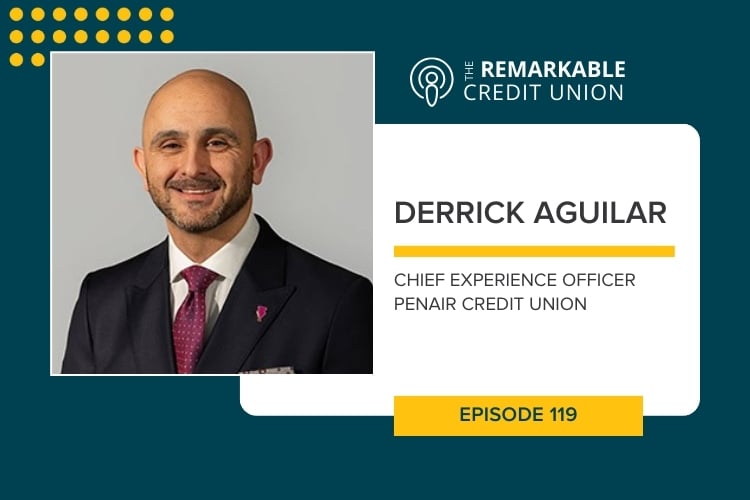
The answers to these questions are not definitive; a lot depends on the approach. We sat down with Derrick Aguilar, a 20-year veteran of the credit union movement and Chief Experience Officer at PenAir Credit Union (a PixelSpoke client), to talk about how credit unions have evolved over the last decades, and how they've stayed the same.
We also addressed this month's BIG question:
How can credit unions grow while never losing sight of their member experience, community roots, and commitment to financial health?
.png)
Key takeaways:
- As much as the credit union landscape has changed, its core purpose remains the same. Despite a rapidly evolving digital landscape and increased competition from fintech and retail giants, credit unions are still about "people helping people." That’s why growth must be "purpose-driven," not just for the sake of growth, with a strong focus on improving member access and financial well-being.
- While branches are also evolving, they remain highly relevant. We've heard a lot of chatter in recent years about the “death of branches,” but the reality is, people are still using them and credit unions are still opening them. The physical branch has shifted from a transaction center to a "relationship anchor" and a "help desk for complexity." For instance, ITMs can be deployed to streamline the simple transactions so that branch staff can be freed up to serve members with more complex needs. This is a shining example of digital amplifying the human touch, rather than replacing it.
- Community and financial health won’t improve unless they’re operationalized. "Operationalize" might seem like an odd way to put it, but the point is that credit unions can’t have meaningful, long-term impact without putting into place specific, ongoing, and widely understood practices to get there.
Resources & links:
- PenAir Credit Union
- Security Service Federal Credit Union
- PenAir's NOW Financial Fitness Competition (meet the winning couple referenced in the podcast)
Read the transcript:
Katie Stone:
Welcome to another episode of the Remarkable Credit Union Podcast. We created our podcast to help credit union leaders think outside of the box about marketing, technology and community impact. The Remarkable Credit Union is brought to you by PixelSpoke, a digital marketing agency that works with credit unions to create user-friendly, high converting, award-winning websites. As a B corp and an employee-owned cooperative, we believe that business can and should be a force for good.
Each episode, we bring on expert guests from the credit union and broader cooperative movement for conversations about the intersection of marketing and social impact. Our goal is to challenge your preconceptions about business as usual and provide you with actionable takeaways that you can use to grow your membership, improve the financial health of your cooperative and better serve your community. I'm Katie Stone, CEO and one of the co-owners here at PixelSpoke.
Kerala Goodkin:
And I'm Kerala Goodkin, also a co-owner at PixelSpoke and the director of marketing and impact. I'm very excited today to delve into our big question, which is how can credit unions grow while never losing sight of their member experience, community roots and commitment to financial health? And to help us answer this big question today, we are joined by Derrick Aguilar. He's the chief experience officer of PenAir Credit Union. And full disclosure, PenAir is a very valued client of ours here at PixelSpoke. And before PenAir, he was an SVP at Security Service Federal Credit Union. He worked there for almost 20 years in six different roles, very impressive.
And on a more personal note, Derrick is married to his high school sweetheart, they have two kids, a 12-year-old boy and a six-year-old girl. And I'm sure Derrick and I could talk a lot about sitting on bleachers, it seems like both our kids play a lot of sports. He's coached a basketball team since his son was four or five. His son also plays competitive travel baseball, golf, he loves chess and he's a history nut. And his younger daughter is figuring out the activities she likes. For his part, Derrick loves to read, listen to podcasts, exercise, he's a Peloton nut, and also travel. It sounds like his family sees travel as both pleasure and education for their kids, exposing them to different cultures, and foods and points of view.
Derrick, thank you so much for joining us.
Derrick Aguilar:
I'm so excited to be here.
Kerala Goodkin:
So in your intro I mentioned you had been at your former credit union for 20 years and I wanted to start there. You started your career as a part-time member service rep during your freshman year of college. I doubt you knew at the time you'd be working in credit unions over 20 years later. Can you talk a bit about what inspired you to stay in the movement?
Derrick Aguilar:
Yeah, it was a total accident first of all. Like a lot of people in the credit union world will tell you, I accidentally stumbled into it. And you mentioned my wife, my high school sweetheart. She's actually the one that got me my job at that credit union where I first started.
Long story short, I was interviewing for jobs in the finance field, in the business field. Needed to pay for school, needed to pay for my living expenses, all that good stuff. I was interviewing at a bank, IBC Bank in San Antonio where I grew up. And I'd just finished up, and I was in a suit from the interview and that sort of stuff. And it was near my wife's work, which was the credit union. So I decided to take her to lunch right after that and I had met her boss before, at the time it was the HR recruiter. She saw me in the suit and she tells me, "What are you doing?" And I told her, "I just came from IBC Bank, I had an interview for a teller job," or what have you. And she's like, "Come into my office."
I sat down and the rest was history. I started working at the branch right down the street from the university I was going to. So that was my start in credit unions and she helped me get my foot in the door. And it was really a paycheck and it was an opportunity for me to gain experience, but it was a college job. But once I got inside, once I started working there, I saw something different. It was really about helping people with real financial challenges. I saw the credit union mission, I saw the purpose and that very much aligned with my own personal values. And I realized pretty quickly that making a difference and doing it with your work is a great way to live and I never looked back. I very quickly made the decision that I wanted to stay and I wanted to continue to work in the credit union space.
Katie Stone:
I love that story, Derrick. It actually reminds me a little bit in a roundabout way of my journey at PixelSpoke. When I started, my primary job duties were things like making sure we were stacked in terms of snacks in the office and doing a lot of the admin stuff. It's been a real pleasure and I think really valuable for me to have grown up through the ranks at PixelSpoke and really had my boots on the ground, if you will.
And I think that that's something that really draws me to the credit union space, too. I think we see it a lot, how the credit union movement really nurtures employees' professional development, their growth, really encouraging folks to grow within the industry.
Derrick Aguilar:
Totally. That's what kept me here is that the credit union, it's just like you said. The credit union movement, invest in people.
Katie Stone:
Yeah.
Derrick Aguilar:
Invest in employees, like you talked about, but it also invests in members, it invests in communities. And over time, it kind of stops feeling like a job. It really starts feeling like a calling. And what I've also learned from that perspective too, from a leadership side of things, is that when people understand the impact of their work early on, they're far more likely to stay, and grow, and hopefully at one point lead and that's what happened to me. Katie, that sounds like that's what happened with you. It's a fun thing to be a part of.
Katie Stone:
Yeah, absolutely. Well, I know that the credit union movement has evolved quite a bit over the past few decades since you started working at your first credit union. Can you reflect a bit on that? What's changed in your tenure, and on the flip side, what's remained largely the same?
Derrick Aguilar:
My gosh, what hasn't changed in the movement? A lot has changed. The technology has obviously evolved. It's crazy to say, I don't feel like I've been in the industry for 24 years, but that's a long time. And during that time, certainly things look very different, not just from a technology standpoint. Consumer expectations have changed, member expectations have changed and they changed throughout that period of time, but accelerated during the pandemic obviously because of the way that things had to be handled and managed.
Competition now comes from outside of traditional financial services. So our competition are no longer just other banks or credit unions. Now you have fintechs, sure, but then you have even retail companies like Apple and you have the Amazons of the world. Competition is everywhere. You have people parking money and using different services to move money in a bunch of different areas and places. So that's crazy.
And the biggest thing for me, and I don't know if it's just because I feel this way because it's today, and it's present and it's in front of me, but I feel like the pace of change has accelerated as well. Maybe some of that has to do with the pandemic as well and feeds into everything I just talked about, but I feel like that's changed a lot.
But what hasn't changed is the mission. So no matter how much the world shifts around us, credit unions are still here to help people, to improve people's financial well-beings and our mantra, people helping people. That hasn't changed. The challenge is making sure that all of this noise, all of these things and it's not all noise, but all of the new tools, all of the new channels, all of these other things that are constantly changing around us don't distract us from that mission, and really should be helping us deliver on it better and that should be the focus. So a lot has changed, but at the end of the day our mission hasn't changed and I don't see it changing for the foreseeable future.
Katie Stone:
Yeah. It sounds like it's the what that has stayed the same, the how is the part that's changed a lot over the last couple decades. Does that sound right?
Derrick Aguilar:
100%.
Katie Stone:
Cool.
Kerala Goodkin:
Yeah. And let's see, I started at PixelSpoke almost eight years ago and I'd heard of credit unions, but was one of those people that's like, "Ah, they don't apply to me, I don't work for this specific employer." I feel like I've seen a lot of change over the last eight years. As you mentioned, the pandemic might have accelerated some of that.
One other thing that I've seen that's change or is changing is credit unions are just getting a lot bigger. How we defined a small credit union eight years ago is actually very different from how we define it now. And yeah, I think that can be a good thing, I also think it can be problematic.
So I'm just curious, you oversaw quite a bit of growth at Security Service Federal Credit Union. It also looks like there's quite a bit of growth happening right now at PenAir. You are a passionate advocate for sustainable growth. That sounds like something that's very aligned with our values here at PixelSpoke. So could you talk a little bit about what this actually looks like in practice? And what dangers do credit unions face if they grow too quickly or if they grow without intentionality?
Derrick Aguilar:
Yeah, totally. First of all, I believe growth has to matter. Can't grow for the sake of growth and doing that will harm an organization. And we can grow pretty easily, and we can do it recklessly, and we can hurt our members in the process and we can hurt the organization in the process as well. It's really easy to approve every single loan that comes through the door. It's really easy to do a lot of things like that that will drive quick growth that's not sustainable and will eventually lead to the bottom falling out. So it's really important to keep that frame of mind that growing for the sake of growth is not the way to grow. And really, sustainable growth starts with a purpose, so that's the part where it has to matter.
So some of the questions we ask ourselves. Are we growing in ways that improve access? Are we growing in ways that improve experience? Are we growing in ways that drive financial health for our member? When the answer is yes, then that growth also leads to financial strength and that's where the sustainability comes in. And financial strength matters because it gives you options. It allows you to invest in people, like we talked about earlier. It allows you to invest in technology. It allows you to invest in services. It allows you to weather economic cycles. And it allows you to give back to the community or the communities that you serve.
So growth without intention strains culture, erodes trust. You're just doing something for the sake of doing it if you do it without that intention. Disciplined growth strengthens the credit union and the institution so it can serve better over the longterm.
Kerala Goodkin:
I love that. Those are some really key questions to be asking.
Derrick Aguilar:
Yeah, and that's it. It's just staying grounded and asking ourselves that simple question. Does this make us stronger so we can serve better?
Katie Stone:
I was actually curious, Derrick, if you can share a little bit more about what does that process look like in practice? How do you evaluate an opportunity to determine does it meet that criteria? Can you share a little bit more about that?
Derrick Aguilar:
Totally. So the first thing is we have to know our members, and we have to know the communities that we serve, and we have to know what those needs are and we have to know what those opportunities are. And if we understand all of those things, which by the way are a lot harder to execute than they are obviously for me to just say, because truly knowing your members and truly understanding what's happening requires a lot of things. Having a mature data program that can bring in the information, having a good pulse on the market, having a good pulse on the economy, all of those things.
And tying those things together I think are critical in helping determine if we're doing the right things to help the people that we serve. And also, understanding what the back end implications of those things are because if you don't build the financial strength around it, as I mentioned. We're a not-for-profit at the end of the day, but that doesn't mean that we don't want to be successful and we don't want to make money because what we do obviously with that profit is we reinvest it back into our members, into our communities, into our employees.
So if we are not taking the time and if we don't have the discipline to truly understand who we're serving and what those needs are, then that's where we can either, A, get into trouble, or we're just throwing money to the wind where we're not really making the right level of investments. And that goes along with everything that we do, whether it's the way we price things, how we underwrite, how we select sites for new locations, what services we want to deploy, what new technologies we want to deploy, how we take care of our employees. All of those things really go into that equation.
Katie Stone:
Yeah, makes a ton of sense. You mentioned new locations and I wanted to talk about that a little bit more. I know that PenAir seems to be opening quite a handful of new branches these days and you were once a branch manager. So how would you define the role of branches in today's rapidly evolving digital landscape? How do those two things work together to support your membership?
Derrick Aguilar:
Yeah. Well, at the risk of using an, I guess overly used cliché and word, the branches are part of an ecosystem. Well, duh, right? And I can't articulate this in a better way so I'll use the word ecosystem, but members don't care about what the channels are per se. They don't think about the credit union in terms of channels. They think about how they get what they need to get done and how it's going to be easier for them. So how do I move my money and is the money going to move in the manner in which I intend it? Or is my debit card going to work? If I need help, is there somebody there that can help me?
So really for us, it's thinking about the branch as a part of that broader ecosystem. And digital channels, as you mentioned, they're incredible for convenience and they're becoming, they've probably already become this, this has already happened, the digital channels, they're the preferred method of banking for the masses. Just general day-to-day banking. But that said, what I've seen is that branches have become the help desks for complexity.
Yeah. So people come into branches during life moments. Buying a home, navigating a setback, planning for the future. Sometimes if the digital channel doesn't work the way it's supposed to work, they're going to come into a branch or call the call center. Or when they simply just want somebody to walk them through something. Sometimes you just need a person to help you walk you through something or give you that level of confidence. So that part's important. Again, I see it as that help desk. The other component of that is that branches also make us real. So planting a flag in a community builds credibility. Even members who may never walk into a branch take comfort in knowing it's there if they ever need it. If something goes sideways, I know that I can go and I can talk to somebody.
So what we've done at PenAir is we've shifted our approach with how we deploy branches and that started with what I mentioned earlier. It's really truly understanding how our members interact with us. And what we're doing is not novel in the industry, other credit unions, and maybe some community banks and maybe some regional banks are doing this. But we've started leveraging ITMs and putting them in the branches and we're making our branches much smaller. So we have two types, we have a 1200-square-foot and a 2400-square-foot branch, and we've eliminated the traditional teller line and put in the ITMs.
And the goal behind that was not only to improve service, but also to make us more efficient and allow us to plant that flag in new communities or communities where we might not have a physical presence, but where we have members or we have potential members from a field of membership perspective.
So the way that we've improved service there is by taking the 97% of the transactions that were happening at the teller line were deposit, withdrawals and loan payments. Those are fairly simple. And we can take of those through the ITM, most members actually choose to use a self-service function on the ITM. But those that need help can tap on the screen and ask for help. And if they don't like the machine, they have somebody that's in the branch that walks them over and then all of a sudden, they have two people helping them instead of one, if you will. So it works well from that perspective.
But then for all of the other stuff, the complexity, the team members in the branch, they're no longer weighed down by the bandwidth suck of the cash operations. If they're a vault teller, they don't got to get up and go do a cash vault sell or buy. They don't have to go give an override, they don't have to go do audits. They don't have to do all of those things. So then what we do and how we train these people is we train them to really focus on the member and we elevate their skillset so we can really solve those problems and be there for those members in their moments of truth.
So we've been able to do that and we've done that by decreasing our footprint. Our smaller one only has three reps, three member advisors as we call them. And these three advisors will open more checking accounts and originate more loans than a branch that has eight or more because of the focus. So they're helping our members in a more meaningful way.
So all of that to say is that my mindset shift over the years, because when I started in credit unions, when I worked in the branches and I was a branch manager, you had a line out the door for teller stuff and that's changed. Branches aren't transaction centers anymore. They're relationship bankers, and they create trust and they support longterm growth as part of that broader ecosystem that I'd talked about.
Kerala Goodkin:
I love that, Derrick. My credit union has a very small branch at a grocery store. It's not my regular grocery store, but I end up there quite a bit because it's close. And I don't go in the branch that much, but I pass it all the time. And like you said, it's just a physical reminder of my credit union. And I also did have to go in there recently, I was changing my last name back after a divorce so it was a major life transition, like you talked about. And I'll admit, I was annoyed that I had to go in, I wanted to just do it all online, but I had a wonderful conversation with the person who was helping me. He had really cool nails, he had gotten a cool manicure. And I see that guy now when I just pass in to do my grocery shopping, so just that personal point of connection can be very powerful. It helps me feel more connected to my credit union.
I know Katie on our last podcast talked a lot about not human versus digital, but human amplified by digital. It's a big, big theme that we talk about at PixelSpoke and the ITMs seem like a really great example of that.
Katie Stone:
Yeah, you took the words right out of my mouth, Kerala. I was reflecting on our last podcast and how we were really thinking about one of the big lessons we learned in 2025 is that technology is an awesome tool for clearing away a lot of the noise that lets the in-branch staff focus on, like you said, the more complex cases. The ones where we need to bring in that human touch or a level of subjectivity. So just really have been impressed with how the credit union industry is embracing the technology as a way to improve member experience, not take away from it.
Kerala Goodkin:
Yeah, and speaking about community involvement I wanted to talk about this particular phrase that's on your website. I'm sure you use it in other materials. I was actually more on the client side back when PenAir was doing their website redesign with us and I was working on the website copy. I just remember loving this phrase you use, "communerosity." So can you define communerosity for us and talk a little bit about how you embrace that at PenAir?
Derrick Aguilar:
Yeah, absolutely. First of all, before I tell you what it means, this is such a great example of how the best ideas come from the most unexpected places. So communerosity, as the story has been told to me because this pre-dates me ... As much as I'd like to take credit for it, I can't. So we have a cash in transit, cash courier operation, we do our own cash in transit stuff. We call it our cash vault. This idea of communerosity came from the cash vault. One of our employees there that's responsible for servicing our ATMs and making sure that all of our branches have money and all that good stuff, the last place you would think it would come from. And this individual basically said, "We're in the community a lot and we're really generous, and I think that if you put those two words together it'd be really cool."
Kerala Goodkin:
I love it.
Derrick Aguilar:
Yeah. So that's such a cool idea that came from an unexpected place. What also matters is that our marketing team immediately recognized when they got wind of it that this is something special and they saw it as an opportunity to define who we are, this articulates who we are. They ran with it and they even went as far as copyrighting it. So we own the rights to the made up word communerosity.
And to me, communerosity defines our soul as a credit union, our soul as an organization. It represents community, it represents generosity, obviously that's the two mash-up, the words that we mashed up. It represents service. And it's not a slogan. In fact, it's one of our three guiding principles. So not only is it a made up word, but the meaning behind it is so near-and-dear that it became one of our guiding principles. And it is more than a slogan, it's more about how we show up, how we build relationships, how we connect with the communities that we serve. And really, a lot of our branding, a lot of our messaging is anchored in communerosity because that's how we try to develop and build relationship with our members and with the communities at scale. You have the hand-to-hand combat, the one-on-one relationships, like what you mentioned earlier, but this is how we as an organization try to have a personality and a soul, and try to relate to our members in the communities that we serve through that.
The lesson for me there, as I came to PenAir and I learned more about communerosity and, this is going to sound kind of weird, but learned how we operationalize it, is that when you find language that genuinely reflects your culture, commit to it fully and build consistency around it. And the more you do that, the more you do that, the more you do that, and the more it really, truly defines you and you're writing your story. You're not letting your story be written for you.
Kerala Goodkin:
That's great. Yeah, it reminds me. I wouldn't say our core values are quite as cleverly articulated as communerosity, but we have six core values at PixelSpoke that, yeah, it might sound weird to say we operationalize them, but I think that part's really important. It's more than just talk, it's more than just writing them on something that you put on a wall and forget about it. We have actually custom emojis that we've designed for each of our core values so that when we see someone embodying them, we can throw them in the Zoom chat or on Slack. Yeah, just something we really try to live, day in and day out.
Derrick Aguilar:
That's a neat idea.
Kerala Goodkin:
Yeah, yeah. And something else I remember that caught my eye when I was working on copy for your website is your NOW Competition. It's a six-month-long competition with a reality show vibe to help participants achieve specific financial goals. And what I love about it is it not only makes financial education personal and entertaining, but it really helps members understand, whether or not they're participating, it helps them understand how to actually break down and reach a financial goal. I think that's something that a lot of us struggle with. Maybe it's not even the how, it's just the focus and the prioritization with so much else going on in our lives.
So I was just curious if you could talk a little bit more about this competition. And are there any particularly memorable stories that have come out of it that you can share with us?
Derrick Aguilar:
Yeah. Well, first off, you're spot on. The NOW Competition is powerful because of the impact it has on the families that participate in it. But it really also serves a bigger purpose beyond those families that participate every year, typically it's three families that go through that six-month. What the NOW Competition does is it shines a light on the financial literacy and financial coaching efforts that we provide every day at PenAir, the services that we provide.
We have certified financial coaches in every branch and in our back office departments, including our collections area, by the way. Because if somebody's going through a hard time, we want to be in a position to help them, not just tell them, "Hey, you got to pay up by the end of the month."
Kerala Goodkin:
Absolutely.
Derrick Aguilar:
That's going to serve that member well and it's going to serve us well in addition to that. And by the way, the coaches that partner with these families in this competition, they are those certified financial coaches in our branches and our back office departments, and they all apply every year to be a part of it. They get selected based on different criteria, just like the families do, which is really cool.
But the competition helps tell that story, the financial literacy story in a human way and encourages members to engage with these services that we offer that are available to everyone. So that's one of the hardest things to do, is to get people to come in and actually ask for help. And a lot of times, our coaches, they end up helping members because they come in for something, say they apply for a loan, they got declined, or the collections example, and then we rope them into, "Hey, maybe we should do this, this is going to help you." But the NOW Competition really helps shed light on that.
One story that really sticks out with me is from last year. There was this couple with adult children and grandchildren, and that right there goes to show you that it's never too early or too late to start a process like this, which is awesome. And the fact that these folks applied and they wanted to do it was amazing. But it was really funny because at the very beginning, the manager, our branch manager in our Foley location, she was at coach for this family and she said, "I didn't think we were going to make it past the first session, let alone a second session." And the family said the same thing too because talk about a gut check and really having to do some really heavy lifting.
So she didn't think that this was going to happen, but they stuck through it and they pushed through it. And with this coach's help, they saved over $10,000 and eliminated more than $7000 in debt in that short period of time, which is great. And then more importantly ... And they were the winning couple. So this was the one with the rockiest start and they didn't think it was going to happen, and then they were fighting at first. Fighting is a strong word, but you know what I mean. "What do you mean, we got to do this? I don't think so, this isn't going to work. And I can't give that up."
So what's really cool though is that they gained a ton of confidence for themselves. And we recently received an update and they've continued on this path, saving path, paying debt path to enhance their financial well-being. But just as importantly, or maybe even more importantly, they've passed this down to their family.
And then of course, we have a ceremony where they all come here and we announce the winners. The amount of tears that were shed with this couple, I think because the journey they went through, I think everybody in the room was crying. I had allergies, I wasn't crying. But yeah, everybody in the room was in tears. It's such a cool thing because the human connection there that we put to financial literacy, and from a leadership and from a marketing standpoint, this is how we tell that story. And hopefully it's lowering the barrier for that engagement that we want. We want people to take advantage of these services, we really want to help them. And it shows members that they don't have to go through this alone, we're there for them. We're there to help them through it.
Kerala Goodkin:
What an inspiring story. I hope we can include some more context or videos in the show notes, I bet listeners would be interested.
Katie Stone:
All right, let's pivot over to some rapid fire questions we have for you today. So don't think too hard about any of these. But would love to hear what is something, Derrick, that you could eat for a week straight?
Derrick Aguilar:
My wife's chicken enchiladas.
Katie Stone:
Ooh, nice. Okay.
Derrick Aguilar:
And it just so happens that I had chicken enchiladas for lunch today. Maybe that's not by accident, maybe it is subconsciously. But yeah, hers, they can't be beat. It has to be hers.
Katie Stone:
Gotcha.
Kerala Goodkin:
Well, we're recording this during our lunch hour and I'm really hungry, and now I want chicken enchiladas.
Derrick Aguilar:
It's got to be green though. It's got to be green for me.
Kerala Goodkin:
Yeah, I agree.
Derrick Aguilar:
Yeah, yeah.
Katie Stone:
Great. What's your favorite day of the week?
Derrick Aguilar:
Mondays.
Katie Stone:
Ooh.
Derrick Aguilar:
Mondays.
Katie Stone:
There's an unusual answer. Great.
Derrick Aguilar:
Yeah. There's something about a Monday where I just feel that I'm ready to take on the world, it's a reset. I feel refreshed normally. Although, as we alluded to earlier, I spend most of my weekends on the bleachers. But I feel refreshed and I feel ready to take on that week and I feel excited about it. So Mondays are always really is where I have the most energy and where I really feel energized.
Katie Stone:
Cool. All right, last question. What's your favorite city in the United States besides the one you live in?
Derrick Aguilar:
Gosh, that's a tough one because I can name a multitude of cities, but I'm going to go with a dark horse on this one. It's El Paso, Texas.
Katie Stone:
Oh, okay!
Derrick Aguilar:
I love that place. I spent some time there, I lived there for a little while, my son was born there. First of all, it's a beautiful desert landscape. I want to say it's the only city in Texas that's got a mountain range right through the middle of it and that's pretty cool. But the people there are amazing. The food there is amazing. The culture there is amazing. And it is just a really feel good place for me. I don't have any, quote-unquote, "business" per se there anymore, I don't have family there. I have a lot of friends there though and I still try to get back. I love that place. Even though it's not my hometown, it kind of feels like a hometown from that perspective.
Katie Stone:
Aw, that's great.
Derrick Aguilar:
Yeah.
Kerala Goodkin:
I love it. Wonderful. Well, thanks for playing along with the rapid fire questions. Now it's time for our final take. So as a reminder, our big question today was how can credit unions grow while never losing sight of their member experience, community roots and commitment to financial health? So in just a few sentences, this might be the hardest part of the podcast, just a few sentences, can you summarize your thoughts?
Derrick Aguilar:
Yeah, absolutely. It really comes back to purpose. Credit unions grow best when growth is, first of all, purpose-driven, but treated as a strategy, not the ultimate goal. That goes back to now growing for growth's sake. The goal is really improving members' lives, that's what we're here to do. And when growth is disciplined, like we talked about earlier, when it's people-focused, when it's financially sound, it strengthens the credit union and allows us to serve better without losing who we are. And I think that's how we grow and that's how we can really stay true to what makes credit unions credit unions.
Kerala Goodkin:
Beautifully said.
Katie Stone:
Yes.
Kerala Goodkin:
Thank you for being concise. Well, Derrick, we really appreciated having you on. We love the work that you all are doing at PenAir and thanks so much for joining us.
Katie Stone:
Yeah. Thanks, Derrick.
Derrick Aguilar:
Yeah. Thank you so much.
Kerala Goodkin:
Wow, that was such a rich conversation. Thinking about some key takeaways. I would say, first and foremost, it just really struck me that as much as the credit union landscape has changed, its core purpose remains very much the same. Derrick has been part of the movement for much longer than I have, over 20 years, and despite rapidly evolving digital landscapes and increased competition from fintech and retail giants, credit unions are really still about people helping people. And that's why Derrick talked about how growth has to be purpose-driven, you can't just pursue growth for the sake of growth, and we need to maintain a strong focus on improving member access and financial well-being.
Secondly, and in a similar vein, branches are also evolving, but they remain highly relevant. I can't tell you how much chatter I have heard in recent years about the death of branches, but that's not what I'm seeing. The reality is people are still using branches and credit unions are still opening them. I loved how Derrick put it though, how the physical branch has shifted and evolved. It's changed from a transaction center to what he calls a "relationship anchor." Or my personal favorite, "a help desk for complexity." I loved that. And I really appreciated his example of ITMs being deployed to streamline the simple transactions so that branch staff can be freed up to serve members with more complex needs. To me, this is a shining example of digital amplifying the human touch, rather than replacing it.
And lastly, we talked about how community and financial health really won't improve much unless they're operationalized. Derrick pointed out that the word operationalize might seem like an odd choice, but the point is that credit unions can't have meaningful longterm impact without putting into plans really specific, ongoing and widely understood practices to get there. I love PenAir's guiding principle of communerosity. And yes, it's catchy, but it's much more than a catchy slogan. He talked about how it's really been operationalized across the credit union. And their NOW Competition in particular seems to be a very concrete way to help members transform their lives.
Well, thanks for joining us today for another great episode. The Remarkable Credit Union is brought to you by PixelSpoke, a digital marketing agency that works with credit unions to create user-friendly, high converting, award-winning websites. As a B corp and employee-owned cooperative, we believe that business can and should be a force for good. You can learn more and check out our work at pixelspoke.coop. That's PixelSpoke, all one word, dot C-O-O-P. Until the next time, I wish you the best of luck in making your credit union remarkable