The end of another year is upon us. Over the course of 2025, we’ve had the opportunity to speak to a wide range of leaders in the credit union movement, delve deep into trending topics, and stay close to industry news.
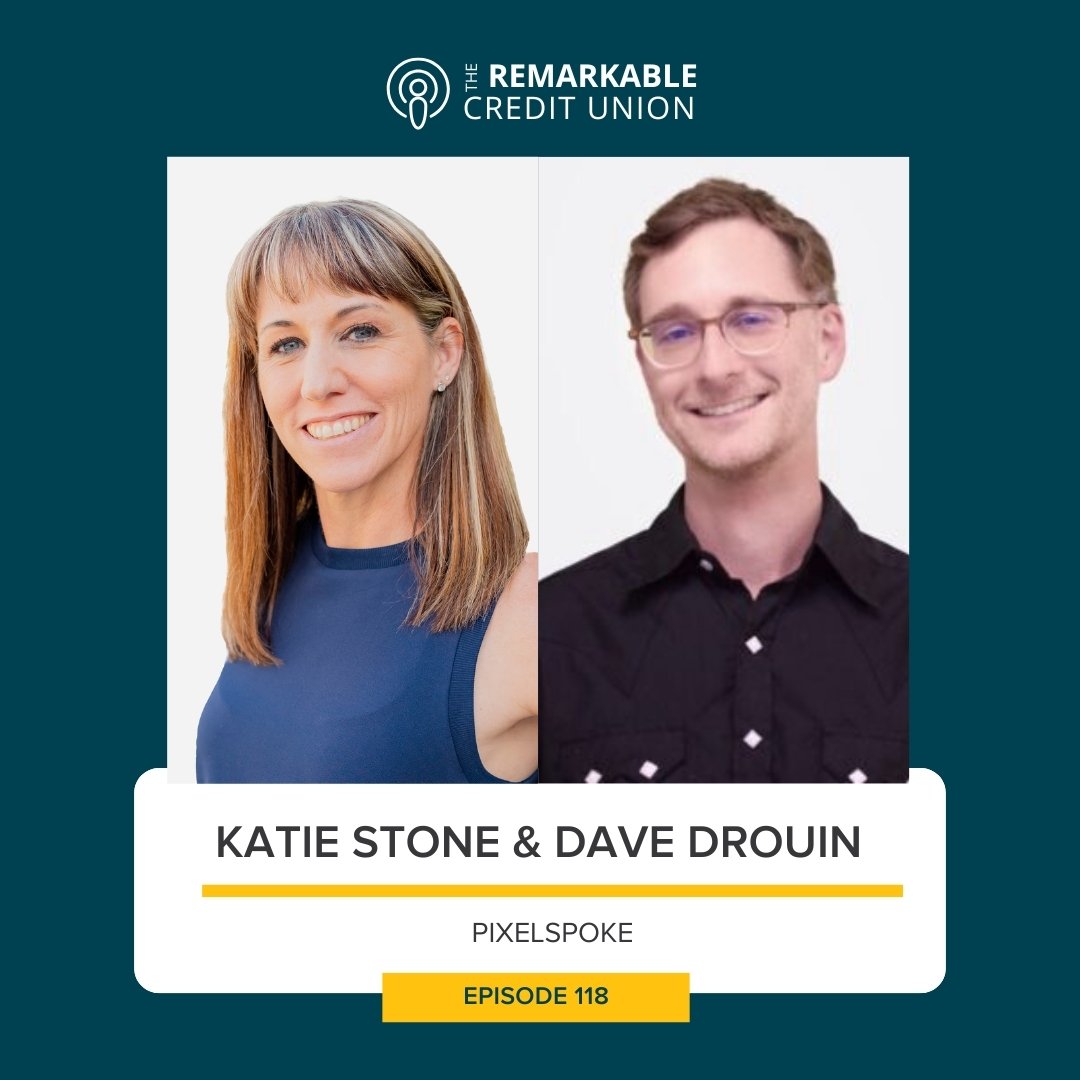
In our final episode of the year, our co-host Katie Stone, also CEO and Co-Owner at PixelSpoke, takes the guest seat, along with PixelSpoke President and Co-Owner Dave Drouin. Together, they reflect on this month’s BIG question:
When it comes to credit union marketing and leadership, what are some of the dominant themes that emerged in 2025, and what should we be keeping top of mind for 2026?
Key takeaways:
- Shift your mindset from human versus digital to human amplified by digital. The credit unions that are most successful in the digital space are using AI and other technology to increase empathy and strengthen member relationships. They are leveraging digital in smart ways, but they’re not so swept up that they lose focus, or the all-important human touch.
- Stay close to your members and measure real impact. Some of the coolest innovations have come out of small credit unions who paid attention and listened to their communities. Proactively ask your members for input and give them opportunities to test your website and digital tools. Make adjustments, not assumptions. The data speaks for itself. And speaking of data, it’s imperative to move away from product-first thinking toward measuring real outcomes, like financial health and long-term community impact.
- Stay true to your values in an uncertain environment. Yes, there is room for innovation and growth, but this is also a time to return to your fundamentals, leverage your deep roots in the community, and take advantage of what you’re already good at.
Resources & links:
Referenced podcast episodes
-
Beyond the Hype: Inside a Credit Union's AI Lending Journey with Ken Brossman, Chief Lending Officer at Marine Credit Union
-
What Gen Z Really Wants From a Financial Institution with Sue Burton, SVP of Experience at Digital Federal Credit Union (DCU)
-
The Crucial Metric That Credit Unions Aren’t Measuring with Andy Bandyopadhyay, Founder & CEO of Attune
-
Beyond Tech Innovation: How BECU is Reimagining Philanthropy with Gloria Dixon, Director of Philanthropy at BECU
-
How to Protect CDFI Funding for Credit Unions by Playing Offense, Not Defense with Armand Parvazi, Strategic Adviser at CUCollaborate
-
Feel Shaken Up by the NCUA Shakeup? Insights From an Insider with Elizabeth Eurgubian, Partner at Atlas Advocacy
-
Beyond Crisis Response: How One Credit Union Proactively Cultivates Joy with Elizabeth Gray & Kathy Mayer at Abilene Teachers Federal Credit Union
-
Micro-Interactions: The Key to Credit Union Growth in 2025 with Samantha Paxton, CEO of Power & Light Collaborative
Industry Resources & Topics
-
NCUA (National Credit Union Administration): Dave cited their report on the 21% increase in net income and discussed "NCUA shakeups." Link to NCUA Data & Reports
-
CDFI Fund: A major point of discussion regarding capital for economically distressed areas. Link to CDFI Fund Official Site
-
CUDE (Credit Union Development Educator) Program: Dave mentioned being in a "DE class" with Andy. Link to National Credit Union Foundation DE Program
-
Inclusiv: Referenced by Dave in the context of the "Inclusiv Conference" and rural Mississippi trip. Link to Inclusiv.org
- Hope Credit Union: Mentioned by Dave regarding his trip to Mississippi and their role in rural banking access. Link to Hope CU
Read the transcript:
Kerala Goodkin:
Welcome to another episode of the Remarkable Credit Union Podcast. We created our podcast to help credit union leaders think outside of the box about marketing, technology, and community impact. The Remarkable Credit Union is brought to you by PixelSpoke, a digital marketing agency that works with credit unions to create user-friendly, high converting, award-winning websites.
As a B-Corp and employee-owned cooperative, we believe that business can and should be a force for good. Each episode, we bring on expert guests from the credit union and broader cooperative movement for conversations about the intersection of marketing and social impact. Our goal is to challenge your preconceptions about business as usual and provide you with actionable takeaways that you can use to grow your membership, improve the financial health of your cooperative, and better serve your community.
And I'm Kerala Goodkin, Director of Marketing and Impact, and a co-owner at PixelSpoke. Today, I'm excited to tackle our big question, which is, when it comes to credit union marketing and leadership, what are some of the dominant themes that have emerged over the past year? And what should we be keeping top of mind for 2026?
You may notice that I'm hosting solo today. That's because our co-host, Katie Stone, who's also the CEO and a co-owner at PixelSpoke, is joining as a guest alongside our President and co-owner, Dave Drouin. Katie and Dave have served as our fearless co-leader since 2024. And Katie has been at PixelSpoke for almost seven years, previously serving as our Operations Manager and our Chief Operations Officer. And then we have Dave, who is our longest tenured Spoker with a 17-year history at the company. He has previously served as PixelSpoke's Creative Director and Chief Creative Officer. Katie and Dave, thanks for joining us today.
Katie Stone:
Thanks for having us.
Kerala Goodkin:
Great. Well, I thought this was an appropriate time of the year to do a bit of a retrospective, and I know both of you are very close to the credit union movement. And I would love to get your insights on just some of the themes that have bubbled up. So Katie, I thought I'd start with you. We both have covered quite a wide range of topics on the podcast this year. We started off with micro interactions, we covered CDFI funding, the NCUA shakeup, most recently AI and lending. And there was so much depth and nuance to each of these conversations, but I'm just wondering if you noticed any particular recurring themes.
Katie Stone:
Yeah, thanks for asking and thanks for inviting Dave and I as guests this month on the podcast. It's kind of fun to be on this side of the microphone.
Kerala Goodkin:
I bet.
Katie Stone:
But yeah, there were a few big themes that kept weaving their way through all of these conversations this year. And the first one was really about thinking through human plus digital as opposed to human versus digital. So whether we were talking about AI and lending, Gen Z or those micro interactions, the pattern was really the same. We talked about how technology really works best when it amplifies the human staff instead of replacing it.
And in particular, I know Ken at Marine Credit Union was talking about how he is using AI to clear out straightforward lending decisions so his team has more time for complex relationship heavy cases and even built an AI knowledge base to boost his frontline confidence rather than cut staff. So really thinking about how technology can support those human interactions and make more room for them.
Secondly, we kept coming back to moving beyond products and feel good metrics to real outcomes and impact. When we had Andy from Attune on, he basically asked the question, if hospitals measure patient outcomes, why aren't credit unions measuring member financial health? And he really challenged us to go beyond workshops, seminars, and donations, and actually track whether the member's savings go up or debt goes down.
Gloria at BECU shared a similar shift on the philanthropy side. So moving away from one-off feel-good projects and towards long-term systems change around economic inequality. Including things like housing stability, workforce development and support for small businesses. So again, really moving beyond the products and really thinking about the impact.
And then finally, there was a really strong theme of being proactive and values-driven in a really uncertain environment. I would say if there was one theme that made up 2025, it was change is here to stay and we don't know what's coming next. And that really resonated through those conversations. When we talked about the NCUA shakeup, Elizabeth reminded us that the shakeup isn't the end of the world, but it is a wake-up call to focus on what we can control. So things like succession planning, cybersecurity, talking to lawmakers. So really thinking about how we can be proactive in how we plan for change and react to change.
And I just want to share one more thing on those lines. Even when we had the folks from Abilene Teachers Credit Union on, they talked about their 325 day. And that is one of my most memorable conversations from this year because we talked about doing more than just showing up during times of crisis. It was really about intentionally carving out space to celebrate local businesses, building that sense of community in place and creating joy just for the sake of joy. So those were some of the themes that really resonated and stuck with me this year.
Kerala Goodkin:
Oh, so much good stuff in there. I'm wondering if out of all of that, and I would have a hard time answering this question because there were many. But are there just one or two aha moments from those conversations, just something you really had never considered before or something that surprised you?
Katie Stone:
Yeah, definitely a couple of those moments. I think one of the biggest was from our most recent podcast with Ken at Marine Credit Union. I really went into that conversation expecting the typical narrative around AI and lending. It's all about efficiency, automation, speed. And yeah, he talked about all of that. But what really surprised me and was more of the aha moment was the intentionality behind how they're using AI to actually increase the amount of human care in the lending process, not reduce it. They're using AI to handle those straightforward decisions so that their team can spend more time on the more complicated, nuanced, emotionally heavy cases that require more empathy and understanding and judgment. They have even built an internal AI knowledge base that helps frontline staff feel more confident when working with members. So it really flipped a lot of my assumptions about how folks might be using AI in the credit union industry.
And then one other big aha moment was, again, going back to our conversation with Andy at Attune. I just really appreciated his analogy to hospitals. It's so simple, but really makes it clear. I think about how hospitals don't measure how many workshops they hosted or brochures they printed. They really are all about measuring outcomes, whether people actually got healthier or not. And when he asked the question, why don't credit unions do the same? It really just hit me. We talk a lot about financial wellbeing, but are those the metrics that we're really tracking and using to determine our impact?
Kerala Goodkin:
Those are two great ones. And yes, I would agree that there were aha moments for me in both of those as well. I wasn't sure what to expect going into the lending conversation, AI and lending. And I've seen things floating around the internet talking about, "Oh, is the credit union motto going to become AI helping people instead of people helping people?" And I'm like, "No." But I loved how Ken talked about AI as a tool to enable people to better help people. So really not losing sight of that central tenant of the movement.
Katie Stone:
Yeah. I guess if I could add one more thing that was a big aha moment, it was when Ken mentioned that not only have they not reduced staff as a result of introducing AI into their processes, they've actually had the opportunity to hire more. And I think that that's just another really tangible way we can see the kind of attitudes towards AI being flipped.
Kerala Goodkin:
Agreed. Well, Dave, I want to get your thoughts. You and I, part of our work at PixelSpoke, contribute to the Slack channel we have, which we call our Industry Insight Slack channel. So we both spend a decent amount of time just monitoring what's going on out there in credit union land. And it's been an interesting year. I'm just wondering from your perspective, what were some of the big headlines of the year and why are they significant?
Dave Drouin:
Yeah, you bet. And shout out to Andy, who was in my DE class last June. So it was really cool to get to spend a whole week, intense week with Andy, great individual.
Yeah, it's been a really big year for credit unions, as you pointed out. I think one of the biggest headlines that maybe surprised me a little bit was just how strong the industry performed financially. So loan growth, deposits, profitability, we're all up according to the NCUA with net income up by 21% year over year, which is pretty incredible. So that's really important. It shows that credit unions are staying resilient, which is something they are good at. And they continue to support their members even when the broader economy is feeling a little shaky.
So secondly, I was surprised by the ... I would say the sheer volume of regulatory pressures coming this year. So how the rules around fees, acquisitions and tax status evolve could obviously very dramatically affect the character and mission of credit unions in the coming years. And you mentioned the CDFI fund, Kerala, alongside the regulatory shakeups, I've been keeping a particularly close eye on the status of that. Which we all know provides capital, loans, financial services to folks in economically distressed areas, funds affordable housing, small businesses, et cetera. And this is all where traditional banks will not step in or step up. So that fund ultimately fosters economic growth and revitalization, and it's kind of hard to argue with that.
And then another storyline was just the record number of credit unions acquiring community banks. So there continues to be a lot of debate around this, but here's one perspective that I will offer up. In lots of towns, credit unions also help keep local banking access alive as banks consolidate or pull out. And I actually got to see this myself firsthand, went on a trip in rural Mississippi as part of the Inclusive Conference a couple years back. And basically the big global bank had left town and Hope Credit Union opened up a branch in the same building where Global Bank was formally. Had they not done that, there would be no financial services in that community except maybe some predatory ones. So I think it's really important to recognize the ability for credit unions to adapt and to be able to serve folks, particularly in some of the areas where financial services are not available.
And then lastly, kind of closer to my heart is digital transformation really accelerated this year. We saw small and midsize credit unions rolling out better mobile experiences, real-time payments, FinTech features. And it's pretty clear now at this point that members are expecting to see how is my credit union like Apple or Chime or PayPal? And those consumer expectations shift towards digital convenience, credit unions risk losing ground unless they do continue to adapt to those. So this wave of innovation suggests that we're not only keeping pace, but actually trying to leverage that cooperative ethos with the modern convenience. So for members, it means better access. For credit unions, it's a potential lifeline to stay relevant.
Kerala Goodkin:
Yeah. So I started at PixelSpoke over seven years ago, and I was very new to the credit union movement. But I feel like back then it was a big deal if a credit union had an online application process. Or I think a lot were rolling out mobile apps, but they were not very user-friendly. And now it just seems table stakes that offer those kinds of services to your members.
So that kind of ties into my next question, Dave, which is more specifically related to credit union marketing. Are there any notable insights you gleaned, maybe not about the broader movement, but just something that could provide some takeaways for credit union marketers?
Dave Drouin:
Sure, definitely. One theme that's pretty huge that we hear quite a bit about is personalization. So on one hand, it's no longer a nice to have, it's the cost of entry. And on the other hand, and Kerala, you and I talked about personalization specifically at Go West MAXX. It can be effective, but it also comes with a lot of risks. So I'm going to flip that around a little bit and just say, a better strategy is to really stay close to our members. Focus on their very specific needs, this is what credit unions are good at. And promote their financial wellbeing.
Another kind of related theme that stood out to me is that marketing is becoming way more guidance-based. So again, we covered this theme at Go West, but if credit union marketers find a way to engage their members through financial guidance and education in that digital space, not only are they fulfilling the mission of the credit union, they're retaining members who would otherwise look elsewhere for that guidance and financial well support. So huge opportunity there to step in.
And then lastly, marketing and the user experience are really blended together at this point. So what a member sees on their mobile dashboard or an onboarding flow is just part of the marketing experience.
The brand lives inside the interface, so it's really important to have that continuity across all channels. Otherwise, members start to get lost and ask themselves, am I still in the right place? Do I trust this space I'm in right now? I'm thinking of specific examples in the marketing journey from top of funnel all the way to the moment that a member goes to fill out that loan application, which you just covered a bit. So that experience has definitely got to be solid and consistent all the way through because that's what folks have come to expect.
Kerala Goodkin:
And I think as we all know, that can be very challenging because we know credit unions work with multiple vendors for that experience. And getting it to be consistent can be a pain point.
And speaking of pain points, Katie, I want to drill down a little further since credit union websites are bread and butter here at PixelSpoke. And you're out there talking to lots of credit unions who are looking to redesign their websites. What are they telling you are some of their biggest pain points? And how do you feel like we're equipped to help solve for them?
Katie Stone:
Yeah, I love this question. They give me a really nice opportunity to reflect on the themes I'm hearing and any consistent feedback we're hearing from credit union clients. And as I was thinking about it more, I realized that while every credit union has their own unique needs, goals and challenges, there are a few pretty basic core challenges that I hear time and time again. And the first one is some variation on our website is hard to update or our current website requires a ticket every time I want something changed. Or there's more I want to do on the current site, but I don't know how to do coding. Just a lot of feedback around how difficult it can be to keep a website up to date. And all of the time and logistical challenges that come with that.
And oftentimes we hear that marketers have just inherited a website that requires either a developer for even tiny content changes, difficulties previewing changes. And it just slows things down.
Kerala Goodkin:
Yeah.
Katie Stone:
So at PixelSpoke, we've designed our custom WordPress CMS specifically so non-technical marketers can make meaningful updates quickly, confidently, and independently. I think that's what I love most about our CMS is it really empowers the staff at the credit union. It's really intuitive. It's got a ton of flexible components. And something that I think is really great too is it also comes with the credit union's brand elements built in. So it's a nice sweet spot between flexibility and conformity. It really empowers marketers to be able to take control of their website, but limits their ability to build new pages that look nothing like the rest of the website. So I love those guardrails.
And then the second big theme that I hear time and time again, especially over the last 12 months, has been something along the lines of, we need a better user experience. Or the site needs better navigation. I hear that one a lot. Or just it needs to be easier for people to find information or take the action that they're on the site to take. And I think the kind of crux of that issue is that while marketers really understand their membership deeply, it can be really hard to translate that understanding into a really intuitive, high-performing digital experience. I think that often we prioritize what we think people need without actually checking in with members to ask them what they need.
And so at PixelSpoke, this has really been a huge focus for us in 2025. We've really been leaning into data more and really understanding what end users want. So that's taken the form in 2025 of a lot more user research and testing. Whether it's heat mapping, card sorting, web surveys, AB testing, or just doing research on UX best practices. We've really just been thinking more and more deeply about information and architecture and building a really seamless user experience.
And not only are we doing that with some of our current clients, we've actually started building more of that into our website redesign process. So that from the outset, we can feel really confident that the website is performing in such a way that makes it easy for users to do what they want to do.
And I just want to share a quote from one of our clients because I think it really speaks to how effective we've been in this area. One of our clients recently told us, they said, "We've been really investing in the analytics insights with Devin." Devin's our Senior Digital Analyst. "And her work has been instrumental in making sure we're setting up pages with users in mind and that we're getting the most we can out of this investment." And I think that that's just really the end goal for all of our credit union clients. Are we serving our membership the best we can? And are we making the most of our budget and our members' dollars?
Kerala Goodkin:
I'm so excited. We're doing more in the realm of user testing. I joined PixelSpoke on the client side in the UX realm and fancy myself pretty well versed in UX. But the insights you get when you just ask users or when you really examine their behavior, it's just incredible. And you can design a page with the best of intentions and using all the best practices, but sometimes for whatever reason, that button would be great if you just moved it over here or maybe this language isn't clear. And just actually getting that feedback from the people using the site is so enlightening.
Katie Stone:
Yeah. And I'll mention one more thing. We did a ton of user testing to inform the improvements we recently made to our ATM Finder. And some of those user testing results were really surprising. Things that we thought were easy to find, weren't or vice versa. It speaks to the power of just observing user behavior and asking people what would work best for them.
Kerala Goodkin:
Absolutely. And speaking of UX best practices, Dave, you lead PixelSpoke's UX design team, and we all know that the fields of UX and design are constantly evolving. I was recently told drop shadows are out, which is a bummer because I love drop shadows.
Katie Stone:
It is a bummer.
Kerala Goodkin:
But what new approaches or trends do you think credit union marketers should be taking note of in 2026?
Dave Drouin:
Yeah, good question. So the space is definitely moving quickly, and I feel like I've been saying that for the better part of 30 years. So I guess that's the way it is.
One thing I do want to mention though is that one trend we're seeing is really more conversational UX. So these are experiences that feel friendly and human and maybe more like talking with someone at a branch. Pretty clear to most folks that people don't want this kind of corporate language in their financial websites and apps. So places where they have been able to thread that needle and make it more conversational, we're definitely seeing some more progress in that area.
And the second thing is, and I don't really think this is a new trend, but some of the things I'll talk about are more like going back to first principles and foundational elements, which is accessibility. I feel like that is so critical. And I'll beat this drum again, it's not about compliance. It's about truly a competitive advantage. So things like clear type, simple layouts, intuitive navigation, intentional content design, these are things that we've been talking about for forever, but are ever more important now. They help members feel more comfortable and confident. This is like, I understand where I'm going, where I am, what I need to do. So it's important to recognize that credit unions serve diverse communities and inclusive design demonstrates that alignment with that mission. So super important.
Kerala Goodkin:
Absolutely.
Dave Drouin:
Yeah. And then the last thing I wanted to touch on is just the mobile simplification. Members want shorter applications, quicker flows, interfaces that work with one hand. So every step that we are able to remove increases those completion rates. I hear all the time from clients, we want fewer clicks. So being able to figure out really smart ways of doing that, it's super important.
So quick story, I recently tried to go through an application process with my own credit union and I did it on mobile just for fun to see what that experience would be like. Could I actually make it happen? I got a decent way through, but I did eventually give up and I had to call the branch the next day. I was filling out the application after work at night. So it was just too clunky and frustrating and it was impossible to do. So kind of going back to all of those different vendors that we're interacting with and having that seamless experience from the front of the website all the way to the completion of the process.
Anyways, I like my credit union. They still have my business, but I will bet they have lost some opportunities along the way from that experience.
Kerala Goodkin:
I'd say on the flip side with my credit union applying for a mortgage refinance a few years ago, it was an unexpectedly delightful process. So again, we know that credit unions can be at the mercy of their vendors and it's a big deal to switch vendors. But when you're able to not just fulfill expectations, but delight someone through a really well laid out process, it's a great opportunity to retain business. And I actually, it's a story I tell a lot, so it can help with word of mouth marketing as well.
Dave Drouin:
Absolutely.
Kerala Goodkin:
All right. So we've talked a little bit about AI, but that's really dominated a lot of headlines this year. So let's talk about it some more. This one's for both of you. AI has been front of mind for us as a company in the digital marketing space and we've developed our first AI policy. We know a lot of credit unions are working on theirs. I'm just curious if each of you could share one way that you've seen AI deployed in the credit union or marketing spaces that excites you? And what is something that makes you a little bit nervous? Katie, we can start with you.
Katie Stone:
Sure. Yeah, AI has certainly been everywhere this year. And there's a lot of hype around it, a lot of apprehension too.
But yeah, I kind of already touched on this a little bit, but the thing that's really inspired me the most in terms of AI this year is when it's used to enhance not replace human connection. So we've seen several credit unions that are starting to use AI to analyze member behavior and surface personalized insights that is helping their frontline staff, their tellers to just have more meaningful, timely conversations. So it's not about automation for automation's sake, it's really about giving teams better context so that they can support members better.
And I think there's a lot of similar promise in marketing. Dave mentioned this a little bit, but how can we leverage AI to increase personalization, anticipate needs, quickly prototype ideas, test messaging? And really just think about content that more closely resonates with our members. So just seems like there's a ton of opportunity to use AI to ultimately create more thoughtful human-centered experiences.
And then on the flip side, I think the thing that makes me most nervous is when AI gets deployed [inaudible 00:26:15] without safeguards, without clarity or alignment with those cooperative values. I think there's a lot of risk and I've seen people fall victim to this in treating AI as a magic solution that just solves everything. And without thinking through potential implications, the opportunity to introduce bias, erode trust, or create unclear decision-making processes, I think that's a big one. If we don't know why decisions were made just that AI made them, it's really difficult to justify those decisions.
So I think that that's what's really important. Credit unions need to really focus on being able to explain how AI works, ensure that it's fair, ensure that you can audit it. And that there's some kind of human touch and screening of AI results. So I guess my excitement and caution are really kind of two sides of the same coin. It's got incredible potential to help credit unions serve members better, but only if it's implemented in a really thoughtful, transparent and responsible way.
Kerala Goodkin:
Yeah, I agree with everything you just said. And right before this podcast recording, I was in a meeting where we were looking at survey results and someone suggested putting them into ChatGPT. The person leading the meeting said, "Why don't we just go through them ourselves and use our brains?" And I think it's just so important. It's like, yes, it can be helpful. But if we just always default to it, we're not always thinking through opportunities to use our brains because our brains are pretty cool too. What about you, Dave?
Dave Drouin:
Yeah, I agree on all that. And Katie said it beautifully, so I'll just parallel and build on that a little bit. Yeah, I mean, I think what excites me the most is that AI can make the digital relationship a little more personal. So for example, when a credit union uses it to offer smarter insights like, "Here's a budgeting tip or you're close to paying off your auto loan." I think about what we talked about at Go West, Kerala, around financial wellness and education. So are there opportunities in there to meet people where they're at regardless of what hour they're filling out that loan application, myself included? And just figuring that out. I think that helps really allow the credit unions to transfer some of that experience that folks are getting at a branch and bringing it home. So I think there's some really good opportunities there and we got to be careful.
So what makes me nervous is just really, I think transparency is the thing I'm thinking about. So obviously we brought up trust. But in finance, trust is clearly important. So if a member is denied for something or they get an alert that they don't understand and nobody can explain that the AI made that call, that can really damage trust. So I'm super excited and also think guardrails need to be in place and folks need to be upfront with their members so that they know how these tools are being used.
Kerala Goodkin:
Well said, well said. All right, we're going to switch gears to some rapid fire questions. Full disclosure, I'm hosting a neighborhood holiday potluck tomorrow and have been fielding text messages about food all week. So all of these are food themed.
Katie Stone:
I noticed that.
Kerala Goodkin:
Yeah.
Katie Stone:
It's also right before lunch, so it's making me-
Kerala Goodkin:
True.
Katie Stone:
... a little hungry.
Kerala Goodkin:
So Katie, what is your favorite ice cream?
Katie Stone:
All right, so you guys both know this, but our audience may not. I have a huge sweet tooth. So for me, the best ice cream is whatever has the most stuff in it. And after some thorough research over the past several decades, I've determined that to be Ben and Jerry's fish food. It's chocolate ice cream. It has marshmallow, caramel, and these little fudge fish swimming around in it. If we could add more toppings on top of that, it's even better, but that's my go to.
Kerala Goodkin:
I'm a fan of ice cream with stuff on it. I need that crunch. What about you, Dave?
Dave Drouin:
Wow, that last lineup was impressive. Good job, Katie. Oh, man. But I'm going to go weird, but also true to form coffee ice cream with fresh strawberries. I just want folks out there go ahead and try that. Trust me, it does work.
Kerala Goodkin:
I have never tried that, but I will. All right, Katie, what about your favorite meal?
Katie Stone:
I rarely eat a meal I don't like. But I mean, sushi is my number one favorite thing. It's always good, there's never a bad time for sushi.
Kerala Goodkin:
What about you, Dave?
Dave Drouin:
All right. Not super specific. I love to cook, so I will say the meal where you can tell the person making that food really cared about it. It does not have to be fancy. My wife and I ate a lot of black beans and rice during her time in school, and that's actually kind of a go to favorite. It's good comfort food. That's probably my favorite.
Kerala Goodkin:
Yeah, I will eat most any meal anyone cooks for me. I'm with you on that one. All right. And now for the fun one, favorite junk food, Katie.
Katie Stone:
Well, I already told you about my sweet tooth. Okay. I can't pick just one, so I'm going to give you guys a couple. I have a really bad addiction to Red Bull. And I'm going to call that junk food since its first six ingredients are all some variation of sugar, I think. I love candy. Candy bars of any kind, but Skittles are my favorite. And then finally, for a more savory treat, if I must, I'm really into Dots pretzels right now. They just ... Yeah, very addicting.
Kerala Goodkin:
I had never heard of Dot's Pretzels, and my daughter is obsessed with them. And they're very expensive-
Katie Stone:
Yes.
Kerala Goodkin:
... and buying them every week, but I guess it's a trend.
Katie Stone:
I'll tell you, Kerala, when I see them on sale, I stock up. They are [inaudible 00:32:14].
Kerala Goodkin:
I should start doing that. All right. And what about you, Dave? Favorite junk food?
Dave Drouin:
I have outsourced my junk food sweet tooth to Katie, so she's got it covered. I'm going to go with a tasty beer. Although I will say that Skittles were a huge hit on Halloween this year. Every age from teenager on down, they all seem to love them. So I don't know what's in those things. Maybe you know, Katie.
Katie Stone:
Sugar.
Kerala Goodkin:
It's my son's favorite candy too. Fruit flavor candy does nothing for me. I need chocolate. And I'm with you on the beer, Dave, although I would not classify that as junk food. I've heard beer has a very strong nutritional profile.
Dave Drouin:
Okay.
Kerala Goodkin:
I'm going to keep telling myself that at least.
Katie Stone:
Many, many years ago, I actually went to the Guinness Brewery in Ireland, and they said there that technically Guinness has all of the nutrients that you need to survive. Now, you'd have to consume an enormous amount to get all of your daily requirements. And there might be some side effects there, but technically you could survive on Guinness.
Kerala Goodkin:
I believe it. Well, thanks, that was fun.
All right, so let's do our final take. As a reminder, our big question today was, when it comes to credit union marketing and leadership, what are some of the dominant themes that have emerged over the past year? And what should we be keeping top of mind for 2026? So in just a few sentences, I'm hoping you can each summarize your thoughts. And let's start with you, Katie.
Katie Stone:
Sure. Yeah. Well, a few clear themes really rose to the top this year. Credit unions are shifting from human versus digital to human amplified by digital. Using technology to create more space for empathy and stronger member relationships. We also saw a move away from product-first thinking, towards measuring real outcomes like financial health and long-term community impact. And finally, leaders are feeling the urgency to be proactive and values-driven in an uncertain environment. So heading into 2026, it's really about intentionality. If I were to sum it up with one word, being able to be deliberate with technology, with our impact, and with how we show up for our members.
Kerala Goodkin:
Great. I would say those are things you and Dave are all doing well at PixelSpoke. Dave, what about you? What are your final thoughts?
Dave Drouin:
Yeah, I think it's going to go back to credit union staying true to their fundamentals and just remembering what we're good at. I think that's the big one for me. Another couple takeaways would be focus on the user experience, leverage the technology in smart ways, but don't get so swept up that you lose focus. And then more broadly, I think credit unions are particularly well-equipped to adapt and serve their members. We've seen that a lot this year, especially and including in volatile economic environments.
Kerala Goodkin:
Yeah, I would not be surprised if we were in for another volatile year, so best to be prepared.
Well, that was a lot of fun. Thanks so much for taking the time. I know you guys, it's a busy time of year for both of you, so appreciate you sharing your thoughts today.
Dave Drouin:
Likewise-
Katie Stone:
Thanks, Kerala.
Dave Drouin:
... thank you. That was great.
Kerala Goodkin:
Thanks.
All right, folks. Well, now's the time we'd normally reserve for key takeaways, but Katie and Dave did such a good job summarizing their thoughts, I really don't have much to add. So I think I'm going to leave it at that.
Thanks for joining us today for another great episode. Really appreciate you all tuning in and hope you have very happy holidays. The Remarkable Credit Union is brought to you by PixelSpoke, a digital marketing agency that works with credit unions to create user-friendly, high converting, award-winning websites. As a B Corp, an employee-owned cooperative, we believe that business can and should be a force for good. You can learn more and check out our work at PixelSpoke.coop. That's PixelSpoke, all one word, dot C-O-O-P. Until the next time, I wish you the best of luck in making your credit union remarkable.