Financial education is a cornerstone of the credit union mission, but traditional approaches often miss the mark. Credit unions tend to treat financial education as a transactional service, expecting information or tools to change behavior, while ignoring systemic barriers, emotional baggage, and the personal circumstances each member brings to the table.
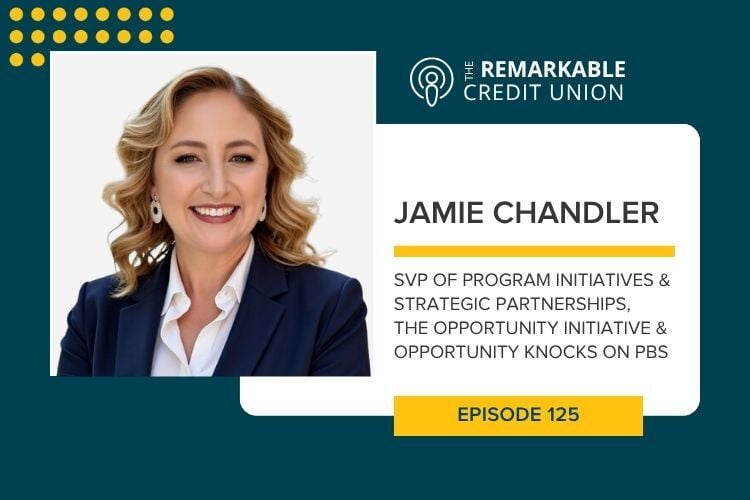
So how can credit unions actually move the needle? In this episode of The Remarkable Credit Union Podcast, Jamie Chandler, SVP of Program Initiatives & Strategic Partnerships at The Opportunity Initiative & Opportunity Knocks on PBS, talks about how credit unions can go beyond standard education efforts to truly understand and overcome barriers to financial wellness. We also delve into this month's BIG question:
What core assumptions about financial health get challenged when you start talking to people in the trenches, and how can credit unions foster more meaningful dialogue?
.jpg)
Key takeaways:
- Go beyond financial education to increase access. True financial wellness isn't achieved just by educating people; it requires removing barriers. Too many credit unions assume that a lack of education is the core problem when they should also be evaluating their products to ensure they’re actually getting to the root of member needs. And let’s be careful with terms like "financial literacy," which can inadvertently shame people by implying they are "illiterate" if they’re struggling financially.
- Acknowledge the emotional weight of money. Money is deeply tied to life events and relationships, meaning frontline financial coaches undergo heavy emotional labor that institutions must actively support. Coaching sessions can uncover intense human baggage — including shame, fear of exposure, and grief — and can even escalate to crisis levels. Let’s make sure you’re offering your members a safe space and that your coaches are properly trained and equipped.
- Move from surface-level community engagement to deep community integration. Sitting behind a table at a local business expo or sponsoring a street fair are both good things, but true impact happens when credit union employees actively serve on local boards, participate in community councils, and deeply integrate with municipal and nonprofit ecosystems. That’s how credit unions can build genuine trust and truly understand the real-world struggles in their communities.
Resources & links:
- Opportunity Knocks — Award-winning PBS reality television show connecting individuals with real financial resources.
- The Opportunity Initiative — Parent initiative encompassing the PBS series and financial access tools.
- National Credit Union Foundation — Nonprofit organization supporting financial health in credit unions (former employer of Jamie Chandler and a PixelSpoke client).
- Rize Credit Union — A credit union highlighted in Opportunity Knocks for community partnership.
- Southern Chautauqua Federal Credit Union — Credit union referenced for developing an innovative high school savings product.
- Inclusiv — Organization supporting community development credit unions.
Read the transcript:
Katie Stone:
Welcome to another episode of the Remarkable Credit Union Podcast. We created our podcast to help credit union leaders think outside of the box about marketing, technology, and community impact. The Remarkable Credit Union is brought to you by PixelSpoke, a digital marketing agency that works with credit unions to create user-friendly, high converting, award-winning websites. As a B Corp and an employee-owned cooperative, we believe that business can and should be a force for good.
Each episode, we bring on expert guests from the credit union and broader cooperative movement for conversations about the intersection of marketing and social impact. Our goal is to challenge your preconceptions about business as usual and provide you with actionable takeaways that you can use to grow your membership, improve the financial health of your cooperative, and better serve your community. I'm Katie Stone. I'm the CEO and one of the co-owners here at PixelSpoke.
Kerala Goodkin:
And I'm Kerala Goodkin, also a co-owner at PixelSpoke and the director of marketing and impact. Really excited about our episode today, and we're going to dive into our big question, which is, what core assumptions about financial health get challenged when you start talking to people in the trenches and how can credit unions foster more meaningful dialogue? And to help us answer this big question, we're really excited to welcome Jamie Chandler.
She has a very interesting bio. She served in the US Army for eight years, before beginning her career in financial services, which was as financial advisor with Edward Jones. And she later spent more than a decade at UFCU in quite a wide variety of roles, but they're mostly focused on helping people improve their financial wellbeing and access opportunities to achieve their goals. And Jamie then went on to serve as director of financial health for the National Credit Union Foundation. Disclaimer, a PixelSpoke client. And she currently serves as SVP of program initiatives and strategic partnerships for the Opportunity Initiative and Opportunity Knock$, which is a reality show on PBS.
And when she's not building partnerships or talking financial health, Jamie can often be found coaching youth gymnastics, where she enjoys helping young athletes build confidence, resilience, and belief in what's possible. I love that. She lives in rural Missouri on 11 acres with her husband, daughter, a very opinionated little French Bulldog and three chickens and a pet turtle. Welcome, Jamie. We're so glad to have you.
Jamie Chandler:
Thanks for having me. I love this whole idea of this podcast and I've had the honor to work with PixelSpoke in my previous role, and so it's great to be here today.
Kerala Goodkin:
Well, it's great to have you. We have so many questions. But first, I would just love to know more about what drew you to the field of financial coaching, advising, especially ... From the army to financial coaching. So what initially drew you and what's inspired you to stay in this field for so much of your career?
Jamie Chandler:
Oh, good question. I love that it has to do with ... I think we all come from our own past lived experiences. When you're talking about finances and behaviors, whether you're a spender or a saver, it really comes down to how you were raised, whether you kind of take on the persona of your parents or reject it completely and go the opposite way. So I grew up with a single mom most of the time and she had gone through several divorces and resetting what that means in life, emotionally and financially every time you do that.
So stability really wasn't a big part of my world, but my mom was incredible about, "We got to do what we got to do to survive." And so there was times when we went to the pawn shop and got a loan, and there were times when we had to choose between electric bill or food on the table. I took that for ... Just seeing my mom make it work. And I think that's what's great about this work is I get to see that again and again and again. These are incredible, incredible people. And that's exactly what they're trying to do is make it work.
After I joined the army and I realized, "What am I going to do now? I'm out of the army. I need to find something to do." And I accidentally became a financial advisor. I truly mean accidentally because I ended up at a job fair at a job booth and they said, "You should be a financial advisor." And I said, "What is that?" I had no background or experience in any of those. And I found that ... There was this whole world that I didn't even know existed and all of these products and services and opportunity that could truly change your life if you just know how to approach it and have access to it.
And when I transitioned to the credit union, then there was this whole other world that I didn't know existed and how to help people with credit and how to help myself with my credit choices and the things that I did. That's what drives me. I think the reality is there's so much opportunity, but opportunity needs access and access needs people who are willing to continue to ask the right questions and continue to figure out, how can we do it better? I know that's what this industry loves to do, and so I love to help that industry do it.
Katie Stone:
That's great. Well, I would love for you to share with our listeners a little bit of an overview of what the Opportunity Initiative is and what Opportunity Knock$, your reality show is, including what motivated you to get involved.
Jamie Chandler:
Absolutely. I will tell you if you told me 10 years ago, or even 5 years ago that I was going to work for a reality television show, I would've told you you're crazy, but it just kind of fell into that. I would say most people know us through Opportunity KnockS on PBS, but the show really is the catalyst for so much more. So the idea for the show was created by our founder, Jamie Strayer, way back in 2020. She had been doing work with our CDFIs or community development financial institutions, and she just saw all this incredible work that was happening and how they were transforming people's lives. But so many people didn't even know that these resources ... They had access to them. So the question became, what if we could tell those stories in a way that inspire people while also connecting people to real solutions?
So we launched Season 1 in 2022. Obviously there was a Season 2. We just launched Season 3 this June. And along the way, the series has earned so many awards, 35 awards and counting for television and social impact. A little tidbit, we've won more awards in our first two years than Sesame Street did. I don't know how cool that is, but I feel like it is.
Kerala Goodkin:
It sounds very cool.
Jamie Chandler:
Yeah. And just last year we won Best Feel Good Show by the Academy of Reality Television beating national recognized programs like American Ninja Warrior and The Bachelor and Shark Tank. It's crazy that a show that's featuring the impact of credit unions and CDFIs and nonprofits and the stories of real humans, real people, our family, our friends, our coworkers can have such an incredible impact.
And today the show serves really as the front door to a broader ecosystem designed to help people improve their lives. And that includes our tools, the Opportunity Finder, which connects people to thousands of trusted community resources, the Opportunity Coach, which helps individuals create personalized action plans and improve their financial health. The Opportunity Hub, which is a training platform that I built using show content to help organizations really talk about this thing called empathy and how does that play out in your day-to-day conversations?
And so what motivated me to get involved really was the realization that not one single organization can solve all the challenges alone. Whether it's a credit union or a nonprofit healthcare provider, foundation, government agency. There are incredible organizations doing parts of that work every single day. We've been fortunate enough to work alongside partners like Visa and Zip, Wells Fargo Foundation, the Financial Health Network, GreenPath. So many places because people deserve access to better solutions and support systems. We just had so much support from the credit union system, leagues, America's credit unions. It has been an incredible trajectory of what a show can create.
For example, one of our credit unions who has been in all three seasons, Rize Credit Union, they've just demonstrated again and again what a financial institution who embraces their role as a community partner and not just a provider can do. I truly love where we're going with this. We actually just had a congressional event here in April right after King Charles left. We were in the Capitol Building, same day. We had United Ways from across the US. We had representatives on both side of the aisles in attendance. We had big banks, credit unions, FinTech. We had everyone there in the same room saying, how were solving this problem, realizing that we all do care about that problem. We all do care about the people that we serve. So why are we doing it in silos?
So that really speared this whole idea of Cities of Opportunity, which is really the next iteration of what the show is doing. And we can speak more about that later, but it truly is something that drives my passion, my work. My love of this work is just knowing that there's so many people out there who really do care about what happens to their neighbors, to their friends, to their families, and getting them the right access and the right opportunities.
Katie Stone:
Well, before we started recording, I shared with you that I binge-watched all four of the episodes from this latest season, Season 3. There are so many things I could say about the show. I was first of all, immediately hooked. Super powerful way to not only share resources, but really share hope, I found. It's a very inspirational show. And I'm just curious to know, what are some of the most memorable moments from the show that really stand out to you and why do you think that those moments stood out? Just through four episodes, I could probably pick three things that stood out to me, but I'm curious to hear from your point of view.
Jamie Chandler:
Season 1, when I'm thinking about what really drove me this deep connection. So in Season 1, we had an incredible couple, Tiffany and Charles. They were pastors in Louisiana and they had gone through a loss of their son, two hurricanes and starting and maintaining a church and all of those things were out of their control. And because of that, they were in this loophole of survival. And that struck me because so many times there's blame to the individual. You should have just made better choices.
But sometimes life happens and when it does, we do what we can with what we have. And that just really hit me because I think so many times, again, we assume versus listen. And when you hear their story, you hear just the exhaustion, the stress. But at the same time, you hear this resiliency of knowing they can have better, knowing they want better, and there's just something there that's blocking that path. And of course, all of the ... Especially in Season 3, as we're talking, the single moms are ... They remind me so much of my mom when it comes to their resiliency, their desire to see better for their children, knowing that if they could just find that thing or that resource, that connection, that access point, they could thrive.
And that's really what that show is, is it connects you to those stories. It's your brother or your sister or your coworker and you say, "I can connect to that. I may not be a single mom, but I can connect to that desire, that stress, the heaviness." Even as an employee of a credit union, we hear those stories every single day at our desk, every single day. We always are saying, "Man, I wish people knew what we did here every day." And this show exemplifies all of that. It puts the camera right there at the desk and says, "Hey, let's show the world what you do every single day to help these people in your community." I can't help but not connect to that story, on both sides of that desk.
And that's what truly drives me to say every credit union, every league, every nonprofit who does this work, how do we do it better? Because it's not solved yet. We still have the same issues, the same struggles, the same frustrations on both sides of that desk, and we need to come up with something better.
Katie Stone:
Yep. Well, I don't want to speak for Kerala, but I think that this season really resonated for me and maybe for Kerala too. We're both women raising our kids without partners right now. And I could certainly relate to a lot of those challenges and struggles. Fortunately, I'm not in the same bind that some of those women are, but I could certainly empathize with the challenges they were facing. And I think that's part of what made the show so powerful for me.
Kerala Goodkin:
Yes, I'll definitely echo that. I've only watched one episode from the latest season and we'll certainly be watching more. I was really struck by just this pervasive sense of shame that these four single mothers shared. At first, you could just feel the weight of their financial responsibility. I've been single momming it for about two years. And before that I was a primary income earner, if not sole income earner, while my husband was in school for many, many years. So that financial responsibility is real when you're responsible for other people, including children.
And in addition to this weight, it was just like this refusal to share their struggles with family and friends or to ask for help. There's so much stigma and this taboo nature of, we're not really supposed to talk about our finances. We're supposed to keep those to ourselves. And it seemed like they were really nervous about meeting with a coach instead of feeling like, "Oh, this coach is going to support me." They were worried that they were just going to get slapped on the wrist for all the mistakes they were making.
I actually met with a financial coach just yesterday to try to get my finances on some sort of track. I felt the same thing. So much I could relate to in that one episode I saw. So I'd love to talk a little more about stigma and shame around people's finances. It's very real and I feel like it's not something credit unions talk about that much. And I'm just curious if you have thoughts on the role credit unions could play in fostering just more open and honest conversations about money.
Jamie Chandler:
Yeah, I think that's an incredible observation. When I was a financial coach for several years at the credit union, I dealt with only employees. We had about 800 employees and I was the coach for anybody who needed one. And I met with over 300 employees over the course of those couple of years. And I will tell you every time there was an assumption of, "Okay, don't get mad at me." Or, "Don't judge me, but here's what I did." And I think it's just because we have assigned right versus wrong choices. But the reality is it's not about a right versus wrong choice. It's about the choice you had access to in the moment.
A story that I like to tell in that, when I was younger and I was five or seven, my mom got into a little fender bender and it was late at night and she didn't have car insurance, not because she didn't recognize that she needed to, not because she didn't want to, but it was a choice. Car insurance or electric bill? And we drove away and we hid in an alley and she was like, "It's okay, they're fine. We're going to sit here for a minute." And just remembering ... I mean, it's a very vivid memory. And I point to that because so many times, especially in our industry, we have assigned right versus wrong, good versus bad behavior.
And so credit unions have a tremendous opportunity to really think about, "How are we defining those choices?" And by defining them, are we keeping people away from our doors because of that judgment or that assumption of judgment? And are we actually judging even when we may not think we are? We need to lean on this idea. People helping people is something that we all internally talk about, but does the public know that? And if they don't, how are we as credit unions really emphasizing that separation?
I like to go on credit union websites, sometimes before I talk to them, sometimes just for fun. And I like to see, "What are you saying about yourself? If I don't know you, what is your website telling me about you?"
And it's very, very rare that their website tells me who they are and who they serve and why they do it and how they do it. It's usually about best rate and their products and services and that's great and that's necessary. But the reality is people do business with people they trust. And when I go to your website, I want to be able to trust you. And to do that, I need to know who you are. And it shouldn't be hidden in a sub-menu of, "Let me tell you about myself." It should be right in the center so I can be like, "Oh, you really care about the youth community." Or, "You really care about the disabled community." That tells me more about who you are and that's who I want to do business with than your rates will ever tell me.
As credit unions transition into this financial counseling more and more, we really need to decide, "Are we doing it because we're checking a box and saying we offer it, check mark." Or, "Are we doing it because we understand that when we lead people to better opportunities, that's going to drive everything else in their lives?" They're going to come back for that auto loan because you helped them when they had no money. They're going to come back for that home loan because you listened to them when they had a 520 credit score and you got them to where they need.
That's one part of it, but the other part of it is access. What do your products and services actually look like for the average person? Do you have a barrier of access? Nobody wants or thinks it's a good idea to take a 500% payday loan. So what stopped them from coming to you in the first place? And so we don't want to judge that. Do you realize you're paying ... Yes, they do. But what did you do to ensure that they didn't have to do that?
Kerala Goodkin:
So many great points in there. As a company that designs websites, we talk a lot about leading with impact on the website and also about financial education being the heart of the business model, rather than this add-on product, which it often seems like it is. It's like you said, checking the box. Okay, we got our financial education page. We have our vendor. All right, box checked.
We presented at the GoWest MAXX Conference last year and it's about flipping the script. It's financial education that is driving the credit union business model and the products and services are supporting that, rather than the other way around. So yes, a lot to think about. And going back to the reality show, to Opportunity Knock$, another thing that struck me was just how emotional the episode that I watched was, and I'm sure others are as well. I was definitely tearing up if not all out crying by the end of it.
And it's so funny because we tend to think of the financial services industry as this very dry, boring industry. I think the stereotype of the suit and tie banker might be not as prevalent as it was, but still definitely a stereotype out there. And we really acknowledge that money is this hugely emotional thing. And I saw you present at the recent Inclusiv Conference here in Portland. You discuss the emotional labor component of financial coaching. I'll admit, it's so obvious when I think about it, but I hadn't really thought about it that much. I think a lot of people assume that you're just doing budget worksheets all day.
So can you talk a bit about the role of emotions in finance and especially when it comes to financial coaching? How are coaches equipped or maybe how are they not equipped to handle this component of the job?
Jamie Chandler:
Another great question. I mean, we all recognize that financial conversation's a subset or a result of life problems or life situations, whether it's divorce or illness or job loss, et cetera. There is a heavily emotional component to all of the financial choices we make, whether it's because of how we grew up or whether it's the situation we're facing now.
And so when I was a financial counselor, I was not prepared in any means, not because we didn't do it right or ... I just didn't realize even in my own self. When we're having these conversations in the branches, they are lighter. "Oh, you came in for a new credit card or an auto loan refinance or a new account." And it's very rare they get too deep. But that transition from the front desk to the counselor's desk is a very different conversation.
And so where people are coming in with the shame and the baggage and the fear of exposure, but then when it is exposed, then there's this hole underneath that you are dissecting because change is variable and it happens over time. So it's not something that you can say, "Oh. We just ... Stop buying lattes and we'll solve all your problems. Wow, it sounds like you never really grieved the loss of your mother. And because of that, your online shopping has become a significant component of your spending. Let's talk about that. When you spend money, why is that making you feel better? Tell me more about that." And recognizing, it's not about the spending, it's the fact that she just wasn't giving herself access to her emotions and grieving of the loss of her mother.
How do I take that on as just another individual, somebody who knows a lot about finances but not a therapist? Am I saying the wrong thing? Am I pushing too hard or not enough and giving space for those emotions? And then what do I do with them afterwards? Because the session ends, now I know this really deep part of this person and I dwell on that and then there's no time to dwell on that. You might have another session right after that. When I talk to a lot of organizations and they're thinking about having continuous counseling and appointments, there's really no thought behind, "How many appointments can someone really do in a day that does not burn them out?" A lot of like, "Oh we'll just do hour sessions every day. We'll do 5 of them or 10 of them and then we'll do it five days a week and we'll be able to help a 100 members a week because we're doing it like this."
Theoretically, yes, but we're not machines and we're people. And so really making sure that when you're building your program, that you're thinking about, "How am I taking care of my people, so that there is no burnout?" Because burnout is a really real thing in this industry because these conversations can get very emotional. I mean, to be transparent, there was a time where I had a potential suicide conversation, just because of the fear of anyone finding out that they were homeless. And I needed time to decompress from that conversation and we were able to get them help. So I went to my manager and said, "I need to take the rest of the day off. I need a minute." And no question, absolutely, 100%.
And so having a very clear guideline of, "Hey, when you're overwhelmed or you want to walk it through or talk it through that there's resources for that counselor and that time is given to that counselor." That they can't be a robot and go back-to-back meetings. There needs to be space in between, in case there is a meeting that's that heavy and they shouldn't be doing that every single day, maybe three times a week or every other day or whatever you see fit. But yes, we want to help as many members as possible. A 100%. And I know that's good in nature, but we have to recognize that our people need space too. And so balancing scalability with the reality of the conversations is really, really important.
Katie Stone:
Actually, it reminds me a ton of one of the women in Season 3, who's a paramedic firefighter. And she says a couple times in the show that ... She needs to be there on someone's worst day. And she actually has a conversation with her supervisor, I think in episode two or three, where he's like, "I know you're trying to work a lot of extra shifts, make money, but I need you to take care of yourself, so that you can be there for people when there is an emergency."
And it sounds like the same approach with this financial counseling. You need to be prepared to be there for someone in a really difficult conversation and you need to take care of yourself, so that you can provide that high level of service and support without burnout. So a really interesting tie-in there to one of the subjects of Season 3.
Jamie Chandler:
Yeah, I know exactly what you're talking about. That hit me too when she said that. I show up on somebody's worst day, so no matter what's happening to me, I have to be there for them. And that's that servant leadership component, the reason why we all do what we do. I will say it is really refreshing to me ... Probably the last year or two, if not two to three years, that this conversation is more broad about, what do we do and how do we help our people? I know off the top of my head that I know GreenPath Financial is doing a lot of this trauma informed work and how do we set up counselors to be better prepared emotionally as well as knowledgeable? I believe Inclusiv is also looking at those things.
It is more of a conversation, but definitely something that as credit unions start to build these programs out more extensively, that they are looking at that as part of that planning process.
Katie Stone:
Well, I'm really glad you're bringing it up. It's such an important component.
Kerala Goodkin:
Absolutely.
Katie Stone:
Well, let's talk a little bit about behavior change. I know that is a really key component of this show and the Opportunity Initiative. We know that financial wellness isn't just about gaining education or acquiring skills. It's really about changing behavior. I mean, oftentimes I think folks have the information they need. It's about the impetus to actually change their behaviors to follow that financial guidance.
This podcast is primarily geared toward credit union marketers, and oftentimes this team is involved in a credit union's financial education efforts. So I'm curious to know when it comes to talking about financial wellness with members and marketing financial coaching programs, what would you like to see credit unions do more of?
Jamie Chandler:
That's a loaded question. I think it's important to recognize, what is it about the show that it's doing that maybe we're not doing elsewhere? And I think it comes down to the human element. So many times we have these incredible member stories that are shared internally to continue to motivate our people and we hide them somewhere in our websites for member testimonials. It feels surface level. And so I think as credit unions try to figure out ... Their question needs to be not what we need to do to compete with banks. The question needs to go back to, what is our origin story and are we living that every day? And if we are, does the world know we are? It's not about what makes us the same, but what makes us different.
We've leaned on that over the years. At some point it felt like it shifted and then we wanted to be like, "We have products and services too, and we have investing and we have insurance, we have all of these things." And we lost the essence of what makes us different. If you're a credit union and you see a community that's not being served, you don't have to wait two years or three years to come up with a product or a solution to serve that community. You can just be like, "You know what? We're going to build this new product and it's going to serve them." And you do it. And now you have a product that's serving a community that didn't exist one year ago. You have the ability to make change and impact your community around you on a dime.
I think it's just having your listening ears on and saying, "Are we truly meeting those we want to serve and if not, how do we ensure that we do so?" I think another part of it is we tend to end at education. So we say, "Oh. They just need financial literacy." But when you say literacy, you're kind of making that person say, "Well, you're illiterate."
Kerala Goodkin:
Right.
Jamie Chandler:
Right. "You're just a illiterate if you only knew better." And don't get me wrong, education is a big component of, "How do I make better financial decisions, help teach me to do so." Education means nothing if their access is not there. So if you're going to go out into communities and say, "This is how you budget, this is how credit works, these are how these things ..." You also need to be taking a look internally and saying, "Are our products and services truly matching the community that we're serving? Do we have micro-lending options? Do we have quick app applications? How are people accessing our website?" All of these things. And then you have so much data as an organization. Take a look at it.
One credit union I was talking to, they didn't realize that only eight percent of their existing membership qualified for mortgages. So all of their mortgages were coming from new non-members because they didn't have a program that allowed existing membership to really be in that space with them. Then they said, "Okay, let's start a new home buyer program. Let's have this .... Because you can't have a seminar about new home buying if no one in your existing membership actually qualifies for a new home with you."
So it's just that kind of self-evaluation, self-reflection that is really important to really driving impact. Education is a component, but it comes down to, do you recognize where you are strong and where you could do better? All of that comes down to letting people know that you have these things and asking, "Hey, we could be doing it better." So having a focus group of your members, going to your community leaders, whether it's the Hispanic Chamber or a large nonprofit. The United Way in your city and saying, "Hey, did you know that we do these things? Or how are we serving your people? Could we serve them better?"
It blows me away a lot of times when we do these national tours and we're talking to these organizations nationwide, they don't know that credit unions are not-for-profit. They have no idea. They don't even know most of the time what a CDFI is and that credit unions can be CDFIs. And so once they realize that, they're like, "Well, you could be helping our clients." And there's a connection made and vice versa. We can't solve everyone and we can't help everyone, but should we be referring them over to our community partners? Absolutely.
I think credit unions can just do better, taking a step back and saying, "Are we doing everything we can with who we are serving, who we want to serve, reevaluating our data, and then deciding where education fits in with access?"
Kerala Goodkin:
So much in there. And I've been thinking a lot lately around about products that actually drive behavior change. We had John Felton, who's the CEO of Southern Chautauqua Federal Credit Union on our most recent episode. And I just can't stop thinking about this savings product they developed where if your kids start saving in second grade and goes through high school and puts a set amount of money aside every year, which is a very reasonable amount. It gets a little bigger as they get to high school and can potentially work jobs, but they're guaranteed to graduate high school with $10,000. And just how powerful that is and how much they learn over the course of many years about saving, about interest. I would love to see more products like that on the market. Really wished I had done something like that for my kids.
Jamie Chandler:
Well, and that's the power of credit unions.
Kerala Goodkin:
Mm-hmm. Yeah, absolutely.
Jamie Chandler:
The ability to make these products and services saying, "Hey, we could do this. We could serve this population better." And that's what makes credit unions special is that ability to evolve and change as needed.
Kerala Goodkin:
Absolutely. Yeah. So I have another potentially loaded question. I believe in the power of behavior change, but I also struggle that ... In the United States, we live in a country that just doesn't do a lot to support our collective financial health, especially compared to other high-income countries. Immediately my mind goes to something like paid federal leave is just something every single other high-income country offers that we don't.
Behavior change is something that's within our control, something that we should absolutely focus on and it might only get us so far. I'm just curious, is there a common denominator you've seen? I'm sure you've seen many people's financial struggles over many years. What is something that you'd like to see addressed more on a structural level or something that would be really powerful for our collective financial health?
Jamie Chandler:
I will say when we do the live event, we did one in Tacoma, Washington. We had 500 people in the Tacoma County area show up for this one-day event and we had learning tracks, we had credit unions, nonprofits, government agencies on point. And it wasn't about brochures, it was about action now. So if somebody needed rental assistance, they got rental assistance that day. If somebody needed utility assistance, they got utility assistance that day. We had resume writing on site. We had childcare, we had a food bank offering groceries for those who attended. We fed everybody lunch. It was such an incredible thing.
We had so many voices in the room saying, "I had no idea. I did not know what was in my backyard. I did not know." I think about, "Well, why is that?" If they got help from United Way, for example. Well, why didn't they ever walk into a United Way? If they got help from a credit union who refinanced that payday loan, why didn't they go to the credit union in the first place? And I think it comes down to, "It's for them, not me." More so than anything.
I have learned so much through this role about the true resources that are out there more and far beyond even when I was at a credit union or at the foundation, just truly how much is out there to help every little part of what you're doing. There's The Acceleration Project, which is a nonprofit that does business counseling for free, for entrepreneurs. There's the AFCP. There's so many organizations who are just out there doing the great thing and doing work.
My point to that is, what the show does is it breaks those barriers of, "It's not for me." Who doesn't love reality television and who doesn't want to be a part of it? It's not an assumption of who walks through that door. Do I need to be this person to walk through your door? It's, "I want to be a part of a reality television show." And I think there's something we can learn from that, especially as credit unions. How are you ensuring that people don't feel like there is a barrier to walk through your door? What does your marketing look like? Where are you being seen in your community? Is it always at a table at an event, versus maybe being in ... Ensuring that your employees are on boards, that they're on councils, that they're hearing the voices of the people that they're volunteering in these spaces and then using those to drive impact. Versus, "Well, we tabled at the chamber event, but that didn't teach you anything. There's still a table between you and that person. And you still have the power in that conversation."
So I really believe that we need to do a better job of ... I'll say infiltrating, but infiltrating your community and empowering your employees to hold these roles in your community and saying, "Yay, I serve on the board of Dress for Success and these are the kind of things I'm hearing and seeing. And how can we, the credit union solve these?" That's where you break down barriers. That's where you start to have real impact. You're not going to do that at a table at an event. Although it's important to be known, that's not where that true end change is going to come from.
So I think that's what Opportunity Knock$ has really taught me is this idea of, "How do you become truly inclusive and truly available to the community and break down those barriers of assumption?"
Katie Stone:
Yeah, I think that's one of the things that really stood out to me about the show. It was really powerful seeing those moments, where these women sat down with someone at the credit union and it wasn't just fill out an application for a loan. It was a very holistic approach. Much like the financial advisors on the show, I really want to understand what's going on. All right, great. Let me go talk to my team. Let's brainstorm ideas for you. Here's how we can help.
I just think it's a really powerful advertisement for the type of assistance credit unions can offer. And you saw from the women on this show how blown away they were. It far exceeded their expectations when they walked into the credit union. If more people were aware of that personal service that is available to them and judgment-free personal service, it would probably encourage a lot more people to take advantage of those resources. I love the name opportunity in the show title. It's all about connecting people with resources to give them the opportunity to make positive change.
Jamie Chandler:
I mean, who doesn't love opportunity? Who doesn't want opportunity? We have a sub-campaign. It's Opportunity Looks Good On Me. And it's true. I have a hat and everything. I love it. And that's just the idea of the Cities of Opportunity. It's more than a show. It's more than a live event. It's more than the technology, but if we put it all together, could we make every city in America a city of opportunity? Could we show that these are real people, your neighbors, your coworkers, your friends, your family? And we all secretly have issues and stresses and financial woes.
And so if we recognize that in each other, then great things can happen. And when we come together ... And that way the municipalities and the nonprofits and the FinTechs and the credit unions in that space, instead of working in silos come together and say, "Let's make a city of opportunity." I think that's the next step, the evolution of this idea of, "How do we solve this problem?" Because it's not education. I mean, you have access to education every turn at this point, but yet we still have 47% of Americans struggling. That's not the answer. We've come to the conclusion, it's not the answer, but then what is?
And so the show really allows people to sit in their rooms, in their private spaces and be like, "That's me." Or, "That's my cousin." And the tools allow that person to have same access. We wish we could have Patrice Washington at everybody's kitchen table. That would be fabulous.
Kerala Goodkin:
She's great.
Jamie Chandler:
She is fabulous. But we've built some tools, the Opportunity Coach and the Finder to say, "Okay. Well, you can't have Patrice Washington, but we can get you to somebody who can have that same type of conversation with you and it's okay." And seeing the credit unions in action in those moments, people are like, "Oh, I didn't know that's how it feels when you walk into a credit union." And that's what we need. We need more people to be like, "I didn't know credit unions are amazing." So the more that we as an organization can do that, then that just does what we're all trying to do, which is give people opportunity.
Katie Stone:
Awesome. Well, let's pivot to some rapid fire questions. These are just for fun. So first up, if you were to start an entirely different career, what would you do?
Jamie Chandler:
I would be a gymnastics coach/gymnastics gym owner.
Katie Stone:
Nice.
Kerala Goodkin:
Love it.
Jamie Chandler:
I absolutely love it. I coach my daughter's gymnastics team part-time. Just being with those girls, seeing them ... All their big emotions and all of their challenges and just pouring into that and just seeing them overtake them. It just truly brings me so much joy in the same way that the show does and the work here does. There's something about it that just warms my heart and I absolutely love it. I would do it full-time.
Katie Stone:
That could be the next reality show. I would watch it. All right. What is your life slogan?
Jamie Chandler:
So something I've always said for many years is true success comes from helping others achieve theirs. As I've gotten older and I've kind of transitioned from that new guy on the street to somebody who's done it and telling their stories of back in my day. I think it's important to just recognize that I am where I am today because I had incredible women bring me to the table even when I really wasn't ready. Who said, "Hey, you need to be here so you can learn and grow in here." And to me, that's what makes them so successful is that they weren't just okay with their own success. They wanted others to feel that and have their own in it. I think that's what makes someone truly successful. When you've hit that point in your career where you're opening doors and you're bringing people to the table, then I would consider myself successful in that space.
Katie Stone:
All right. And what is your favorite city in the United States besides the one you live in?
Kerala Goodkin:
Or I guess you're not necessarily-
Jamie Chandler:
That's hard because I traveled a lot in the military, I travel a lot for work. Okay. If I had to choose, I'm a big US history nerd. I absolutely love US history. So I would pick Savannah, Georgia. It's very random. I don't have family there. I've only visited for work a couple times, ut it's just ... The culture, the architecture. You feel like you could have been on that same street 250 years ago. I love what it brings as far as that goes. So that's where I would pick.
Kerala Goodkin:
Mm-hmm. Great.
Katie Stone:
All right. I have one bonus question because I too have a very opinionated French Bulldog. So what is your French Bulldog's name?
Jamie Chandler:
Oh, my goodness. Her name is Lily.
Katie Stone:
Ah.
Jamie Chandler:
And she's two and a half. And I tell you what, they're just pure joy.
Katie Stone:
Yes.
Jamie Chandler:
She's just pure joy, pure joy and love. We call her a heat seeking missile because she will find a lap, a sun spot, a heating pad. As long as it's warm, you'll find her there. Snoring, of course. Yes, but she truly ... And on 11 acres, that girl owns it all. She loves to go out adventuring and she'll come back with weeds all up in her face. She stays busy.
Katie Stone:
Well, I can relate to that. Greta, my friend, she just turned four and I shared a video with the team yesterday of her romping around in the mud in my backyard. She got plenty dirty herself.
Kerala Goodkin:
And Greta makes occasional appearances on Zoom, which I always enjoy. All right, so let's do our final take. This is a reminder, our big question today was what core assumptions about financial health get challenged when you start talking to people in the trenches and how can credit unions foster more meaningful dialogue? So we just have a couple minutes and in just a few sentences, can you summarize your thoughts on this?
Jamie Chandler:
Okay, I'll try. I would say the biggest lesson I've learned is that most people don't need more judgment. They need more access. And when we take the time to understand someone's story, we often discover, they're not lacking motivation. They're lacking visibility into the resources, relationships, support systems that can help them. And credit unions do have a uniquely positioned opportunity to bridge that gap because they're built on people helping people. And I believe that with every ounce of my being. And the more we reduce that shame and create honest conversations in the branches, out in the communities, we can connect people to real solutions with people who truly care about them and truly want them to be successful. And I just think that credit unions need to recognize their power because they have the power to really make impact. They just need to figure out what that means for them.
Kerala Goodkin:
Well, as the case with most of our guests, I feel like we could keep talking for hours, but we will leave it there for now. Jamie, thank you so much for joining us today.
Jamie Chandler:
Thank you for having me. I could talk to both of you forever.
Kerala Goodkin:
What a rich conversation. Thinking about some key takeaways, I think first and foremost, it's clear that as credit unions, it's really important to go beyond financial education and to focus on also increasing access. Education is a component to be sure, but true financial wellness is really achieved when we remove barriers. And I worry that too many credit unions assume that a lack of education is the core problem. And you should also be evaluating your products to make sure that they're really getting to the root of member needs. And let's be careful with terms like financial literacy. It's well intended, but it can inadvertently shame people by implying they're illiterate if they're struggling financially.
And secondly, let's acknowledge the emotional weight of money. Money is deeply tied to life events. It can be a huge daily stressor. It can be tied to our relationships. And that means that frontline financial coaches are undergoing a lot of heavy emotional labor that credit unions must actively support. As Jamie mentioned, coaching sessions can uncover some intense human baggage, shame, fear of exposure, grief. And can even escalate to crisis levels. Let's make sure that you're offering your members a safe space and also that your coaches are properly trained and equipped and that there are measures in place to prevent their burnout.
And lastly, how can credit unions move from surface level community engagement to deep community integration? There's absolutely nothing wrong with sitting behind a table at a local business expo or sponsoring a street fair, but true impact really happens when credit union employees are actively serving on local boards. When they're participating in community councils, when they're really deeply integrated with municipal and nonprofit ecosystems. And that's how you can build genuine trust and also how you can truly understand the real world struggles in your communities.
All right. Well, thanks for joining us today for another great episode. The Remarkable Credit Union is brought to you by PixelSpoke, a digital marketing agency that works with credit unions to create user-friendly, high converting, award-winning websites. As a B Corp and employee-owned cooperative, we believe that business can and should be a force for good. You can learn more and check out our work at pixelspoke.coop. That's PixelSpoke, all one word, dot C-O-O-P. Until the next time, I wish you the best of luck in making your credit union remarkable.