

Most credit union employees can identify problem areas in their daily work, but how many problems are they actually empowered to solve?
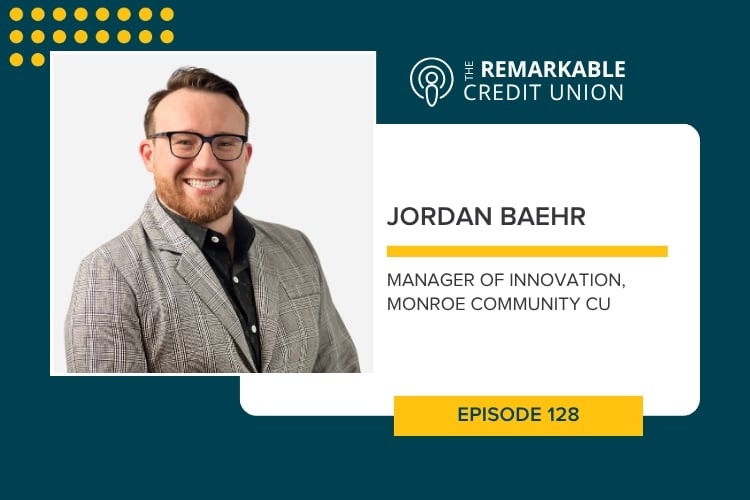
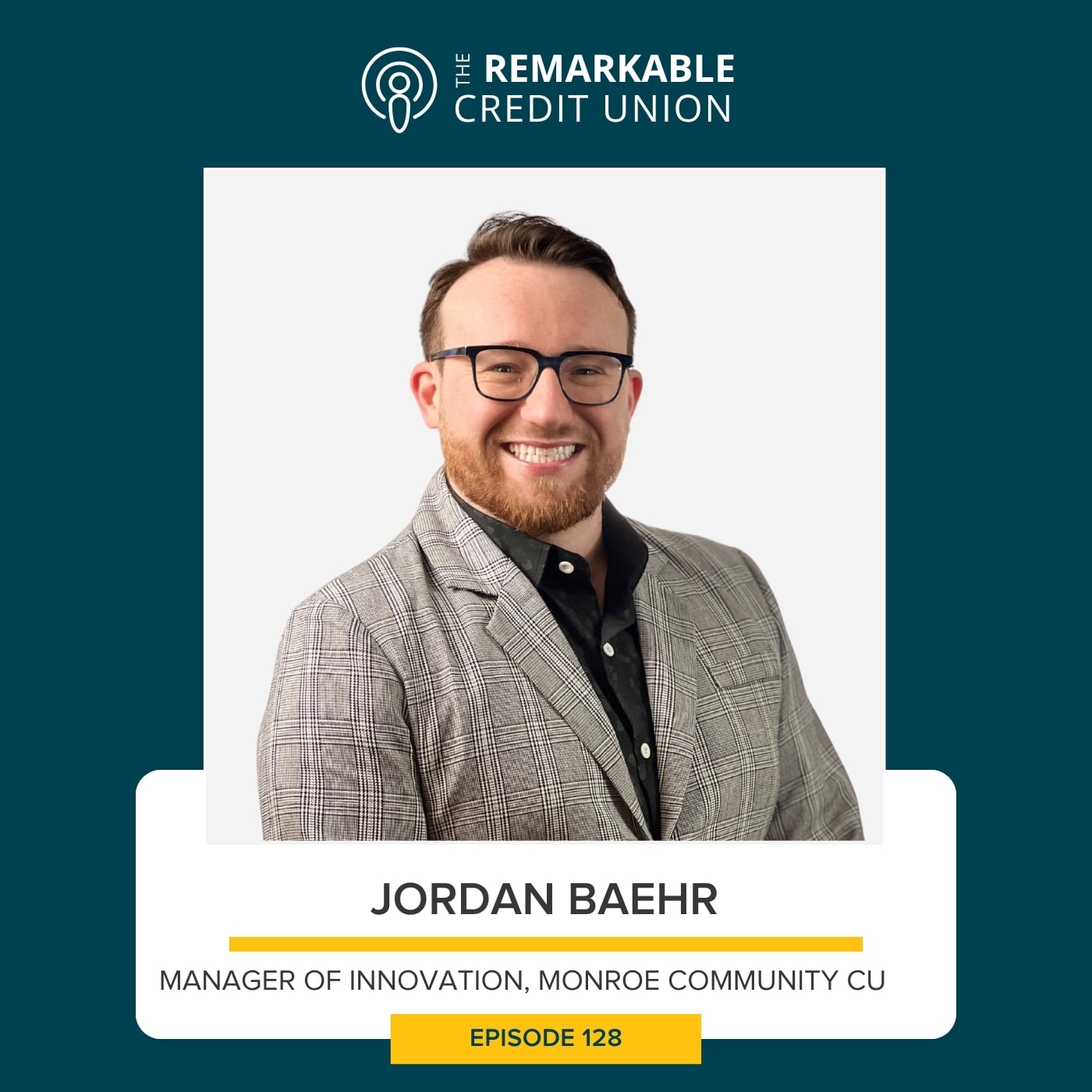
In this episode of The Remarkable Credit Union podcast, we sit down with Jordan Baehr, Manager of Innovation at Monroe Community Credit Union and recent winner of the “Team Member of the Year” award from the Michigan Credit Union League. We talk about what innovation really means for credit unions and why it's so critical for those closest to the friction to help design the fix.
Jordan reflects on his journey, which began as a teller 11 years ago, and discusses his approach to breaking down silos, fostering collaboration, and embracing a cooperative ethos can transform organizational culture and member experience.
Together, we tackle this month's BIG question:
In today’s rapidly changing world, what does innovation mean in the credit union movement, and where can credit unions focus their efforts to be most impactful?
Key takeaways:
- Innovation is rooted in problem-solving, which may or may not involve technology. Innovation and tech are often seen as synonymous these days, but it’s important to remember that technology is just a tool. True innovation focuses on people-centered solutions that speak to the specific needs of members and communities.
- Empowering employees to take ownership drives meaningful improvements. An ownership mentality is critical to improving culture, processes, and workflows. Credit unions thrive when they break down silos and particularly when they encourage frontline staff, those closest to members, to solve the problems that members are surfacing for them.
- Success should be measured by value and sustainability. Rather than simply tracking project completion, successful initiatives create lasting value—such as improved member experiences—through sustainable, scalable systems. If only one team member can solve a problem, that’s neither sustainable nor scalable. The solutions need to be shared and incorporated across the credit union.
Resources & links:
- Monroe Community Credit Union: A credit union serving the state of Michigan and three Ohio counties where guest Jordan Baehr serves as Manager of Innovation.
- Michigan Credit Union League: A statewide institution that advocates for the credit union movement by building relationships, defending issues, and engaging in strategic election participation. .
- Team Member of the Year Award: An award granted by the Michigan Credit Union League to honor a credit union team member who has excelled in their position and is making a difference for their credit union, clients and co-workers.
Read the transcript:
Katie Stone:
Welcome to another episode of The Remarkable Credit Union Podcast. We created our podcast to help credit union leaders think outside-of-the-box about marketing, technology, and community impact. The Remarkable Credit Union is brought to you by PixelSpoke, an employee-owned cooperative that works with credit unions to create user-friendly, high-converting, award-winning websites. Each episode, we bring on expert guests from the credit union and broader cooperative movement for conversations about the intersection of marketing and social impact. Our goal is to challenge your preconceptions about business as usual and provide you with actionable takeaways that you can use to grow your membership, improve the financial health of your cooperative, and better serve your community. I'm Katie Stone, CEO, and one of the co-owners here at PixelSpoke.
Kerala Goodkin:
And I'm Kerala Goodkin, also a co-owner and the director of marketing and impact at PixelSpoke. And today we're going to tackle our big question. In today's rapidly changing world, what does innovation mean in the credit union movement and where can credit unions focus their efforts to be most impactful? And to help us tackle this big question, we're excited to welcome Jordan Baehr, who has worked at Monroe Community Credit Union for over 11 years. He has held seven titles during his tenure, starting with teller, yet another guest that started as a teller and currently serving as manager of innovation. He recently won a very high honor, Team Member of the Year from the Michigan Credit Union League, and Jordan has a wife and two beautiful children that serve as his inspiration every day. Thanks so much for joining us, Jordan.
Jordan Baehr:
Yes. Thank you guys so much for having me.
Kerala Goodkin:
So I was just really curious about your role as manager of innovation, and I'd love to learn a little bit more about what you do and what efforts and initiatives you help drive at Monroe Community Credit Union.
Jordan Baehr:
Yeah, my role here at Monroe really sits at the intersection of identifying problems and helping find solutions. Sometimes that can mean facilitating conversations between different departments. Sometimes it means analyzing data, and then sometimes it really means rolling up my sleeves and building something myself. One example recently that we went through, so we do financial reality fairs, which I know a lot of credit unions do for our local high schools. The Michigan Credit Union League offers a really good starter program for credit unions to start that process, but it's all manual, all done on paper. I was just thinking one day, "There's got to be a better way to do that." So I dug in and built an app. So we call our financial reality fair our Budget Boot Camp. So I built a Budget Boot Camp App.
I am not a developer. I've never done anything like that before, but we really found an opportunity to improve the experience, not only for our volunteers, but for the students themselves. Rather than accepting the limitations of the paper and all that process, I really dug in and taught myself how to build that app and find a better solution. And that's kind of really how I view innovation in my role. It's not necessarily about having all the answers, but about being willing to take ownership of the problem and learn something new along the way.
Katie Stone:
That's really cool. And it really feels like you're meeting people where they're at too. When you're talking about your audience being students, I would guess that they would be much more engaged with an app than paper and pencil. So it really speaks to your ability to meet people where they're at as well. I'm super intrigued. Not a lot of credit unions have a manager of innovation, and the award you received recently from the Michigan Credit Union League recognized your collaborative leadership style and your commitment to the cooperative spirit. I was reflecting on the fact that your credit union even has a manager of innovation. So I'd love to hear more about how this cooperative ethos plays out in your day-to-day work and at your institution.
Jordan Baehr:
Yeah, I really think the cooperative spirit, and you said it yourself, it shows up in our collaboration as a team. I think the most meaningful improvements that we can have require multiple departments working together. I think it's very few and far between that challenges belong entirely to one team. So being able to collaborate and see different points of view on those issues really makes a difference. And one thing I've learned over the years is that people are usually trying to do the right thing. They're just limited in their view and they only have perspective from their own seat.
Katie Stone:
That's a great insight.
Kerala Goodkin:
Yeah, we're embarking on our own project at PixelSpoke to try to figure out how we can work a little more collaboratively. And I mean, it's a classic challenge for organizations, especially as they grow. It seems like credit unions have gotten quite a bit larger over the past few decades, and with that comes silos. And it seems like part of your role really is breaking down those silos and figuring out how departments can work together.
Jordan Baehr:
Yeah. And I think I have a unique perspective too, because when I started, you had mentioned, I started out as a teller over 11 years ago. I think we were just over 100 million in assets. So I've been able to see the credit union grow and see where those gaps might've been and try to close those gaps.
Kerala Goodkin:
And that frontline experience I think is so valuable.
Jordan Baehr:
Absolutely.
Kerala Goodkin:
I did many years of pizza making and bartending and have kind of joked, it's not really a joke, but I just feel like everyone should hold a service position at some point in their lifetime. I feel like it offers valuable perspective, is good for humility, just a lot of good skills.
Jordan Baehr:
Absolutely.
Katie Stone:
Yeah.
Kerala Goodkin:
Yeah. So coming back to innovation, we see that the credit union movement is often perceived as "behind," I'm using air quotes here, the innovation curve. And usually that's because so often innovation is conflated with technology and they're kind of seen as behind the technology curve. But also innovation doesn't have to mean technology. I mean, you mentioned an app. There are a lot of ways that technology can add value, but I also just see many areas where credit unions are bringing really unique solutions to some pretty thorny social issues. So I'm just curious, where do you see credit unions leading the innovation curve and where do you think your credit union in particular stands out?
Jordan Baehr:
I think credit unions have a really unique perspective on innovation. A lot of times we compare ourselves to FinTechs or large banks based on their technology, but you mentioned innovation doesn't have to be just technology. I think technology is a tool that we can use to innovate, but really innovation to me is problem solving, solving a problem. So I think where credit unions really excel is their people-centered innovation. We have a really unique ability to understand the communities that we work in, understand our members as individuals, and then adapt solutions that fit their needs. So my credit union might have different needs and different solutions than a credit union down the road because we have different members.
So whether it's financial education, helping members through a difficult situation or creating very specific products or services that meet our members where they're at, we're not just trying to fill the pockets of shareholders. So one thing at Monroe that I think we do particularly well is listening. We spend time understanding our members before we just jump straight into building a solution. One thing that comes to mind is a little while ago when there was a government shutdown, we have a lot of employees that hold government positions, so we offered relief packages for them so they didn't feel that impact as hard of not earning their paycheck.
Katie Stone:
I know you just talked about really each credit union having their own unique needs and challenges to solve. My next question is asking you to zoom out a little bit. When it comes to innovations, where do you see the biggest untapped opportunities for credit unions in general?
Jordan Baehr:
Yeah, I think one of the biggest untapped opportunities is empowering the employees of the credit union to act on ideas they already have. Every credit union has people who see inefficiencies in their everyday work, but I think the challenge that many organizations have is they unintentionally create environment where employees think that that innovation is somebody else's responsibility. So in my experience and what we've really tried to do at Monroe is involve our employees with our projects and initiatives, and some of the best improvements we've seen come from the people that are doing the day-to-day work.
Katie Stone:
It really makes a ton of sense. Those are the people that are directly influenced by those challenges on a day-to-day basis. They're certainly oftentimes the best equipped to help solve them.
Jordan Baehr:
Absolutely.
Kerala Goodkin:
Yeah. Financial education is certainly a theme that comes up a lot in our podcast episodes, and it always goes back to what you're saying is just listening, listening. Don't just purchase a suite of tools from a vendor that teach people about financial wellness and put it out there. Those can be useful, absolutely, but there's so much more to financial wellness and it really starts with each person's unique circumstances, including just the emotional baggage they carry around money and some of the stigmas they might feel that are preventing them from seeking help. So I love that. And then in addition to listening, I feel like that's kind of where things start. And then there's the measurement piece, and you mentioned that you have a background in data analytics. So I'm just curious how you measure success in your role. And it sounds like you are involved in some pretty varied initiatives, but yeah, are there certain ways that you measure success with your projects and in your role in general?
Jordan Baehr:
Yeah, I try not to measure success simply by whether a project was completed, but for me, success is really about creating value. Did that project create value in either the member or a process or our employees? So depending on the initiative, that might be reducing processing time for a certain process or improving accuracy or experience, increasing member adoption or reducing risk. So it kind of just depends on that initiative or that project that we're working on. But I also look at sustainability. If a solution only works because a certain person is constantly holding it together, that's not very sustainable. So it might work in the moment, but it's not a long-term solution, so we got to keep working. So long-term success really means building a process and systems that are understandable, repeatable, and scalable.
Kerala Goodkin:
That's a really good point. And I'm just curious about the app. Were you able to look at the usage of that and did you feel like that or if you took away learnings or felt like overall that has been a success?
Jordan Baehr:
Yeah, so we introduced that app, I want to say March or April when we did one of our financial reality fairs with one of our larger high schools, and we put out a survey to the students and kind of gauged their interaction. And some of the students had gone through a similar program before where it was all paper. So it was really useful to get their input to see, did it really make a difference? And it did because that's kind of how they're living their lives already. All of our banking is done on our phone, so it makes sense that this financial reality fair is also on our phone.
Katie Stone:
Well, one byproduct of all of the mergers and acquisitions in recent years is that credit unions are getting bigger and bigger, and often this means, Kerala used this word earlier, more silos and more bureaucracy. But we know that innovation, as you already spoke to, isn't confined to one department. And honestly, that's one of the things that I think is really cool about your role is it seems like you get to be involved with and connect and touch so many different areas of the business. Wherever there's a problem, that's where your attention seems to be focused, which is a really neat role I would think to be in. I'd love to hear how do you put that cooperative spirit to work in your role? How do you bring people together in your day-to-day work?
Jordan Baehr:
Yeah, as we mentioned before, I've held seven different positions at the credit union, starting from teller, worked my way all the way up to where I'm at now. So I think having those different perspectives, I can more easily relate to other team members. I've seen how the work gets done and I've been in it firsthand. And because of that, I can usually understand why a process exists the way that it does, even if it might not be the best approach anymore. So what I try to do is help people connect the dots. Every department has its own goals, priorities, challenges, but ultimately we're here to serve the member. So if the member doesn't have great experience, then something's got to give. We got to change something. So when we're talking about innovation, I usually focus less on finding the next big thing and I'm more focused on helping teams work better together.
If a process is frustrating for employees, chances are it's eventually going to impact member experience too. And I think that's kind of where our cooperative model really shines. We don't have to figure everything out on our own. Some of the best solutions I've seen come from bringing people together with different perspectives and letting them solve the problem collectively. So honestly, a big part of what I enjoy about my role is helping people see the bigger picture, find a common ground and have everyone work together to build something great.
Katie Stone:
I think that is great. I don't know, this podcast feels like a real sales pitch for every organization having a manager of innovation. My wheel's already turning. Maybe we need one at PixelSpoke. I love it.
Kerala Goodkin:
Yeah, I was thinking the same thing, and I'm just curious how problems surface for you to solve. It seems very varied and maybe there isn't a singular process, but how do you go about collecting feedback from different departments or do people just know to come to you? They're like, "We got a problem. Jordan's the one."
Katie Stone:
Yeah.
Jordan Baehr:
I've been called the go-to for quite some time. So a lot of people come to me, even if it's not something that I'm necessarily knowledgeable about, because they trust that I'll find the information that they need. But they can either come to me directly, they'll bring it to their manager. We do round tables at our leadership meeting every month, so I really take note of any issues that other departments are expressing that they're having, and then I'll go meet with them directly and kind of flesh out more details and see what we can work on.
Katie Stone:
How many initiatives are you working on at any given time? I'm just curious, is it you've got one focus for this quarter or is it like you've got seven things in the works at all times or what does that look like?
Jordan Baehr:
I'm touching some part of every initiative that we have at the credit union, even if I'm just sitting in a meeting listening just to give the perspective from an outsider, just so we can think of different ways to solve a problem. I personally am leading usually two to four initiatives at any given time though.
Katie Stone:
Okay. One last kind of off-script question. So was this a role that was created for you or was this a preexisting role at the credit union before you moved into it?
Jordan Baehr:
It was not an existing role prior to me stepping into it. I don't know if it was created specifically for me, but it's a lot of stuff that I was already doing in my previous role that my leaders here at the credit union recognized and really dove into and made a space for me.
Katie Stone:
That's awesome.
Kerala Goodkin:
That's a good question. I was wondering the same thing. Yeah, and I also, I'm just thinking about the power of serving in multiple roles at the same organization. We are an employee-owned cooperative, which is a little different from a member-owned cooperative. But one thing I appreciate about that model is that everyone is in the role they were hired for, but if they become a co-owner, they might be heading up the finance committee or might serve as board president, or it's just a different lens to look at the organization. And I think there's a lot of power in that. And I'm just curious, looking forward and thinking about the various things you're working on now, where do you hope to see Monroe Community Credit Union in 10 years, and then zooming out a little bit about the credit union as a whole?
Jordan Baehr:
Yeah, I really hope that Monroe Community Credit Union is continued to known as an organization that's adaptable, that technology is going to continue to evolve, member expectations are going to continue to change, and the organizations that thrive, they'll be the ones that can learn and adapt without losing sight of who they really are. I'd really love to see Monroe Community Credit Union continue growing while maintaining the community focus that we're known for. For the movement as a whole, I'd really love to see credit unions continue sharing ideas, learning from one another, being collaborative. I think that's one of our greatest strengths. I think it's only going to become more important as the pace of change increases.
Katie Stone:
All right, let's switch gears a little bit. I have some rapid fire questions for you just for fun. So the first one is, if you could travel back in time, what period would you go to?
Jordan Baehr:
That's a good question. I was born in the early '90s, but I always heard stories of my mom growing up in the '80s, and I think that's a time that I would really like to experience. Technology was kind of in a sweet spot. It was starting to make difference in life, but it wasn't every aspect of it.
Katie Stone:
Yep. Awesome.
Kerala Goodkin:
Well, Katie and I both have experience with the '80s [inaudible 00:19:45] ourselves.
Katie Stone:
Be careful what you wish for, Jordan. If you're in the car in the '80s, you got to have an atlas next to you to get around. There was no GPS.
Jordan Baehr:
That true. I have little directional strength, so ...
Katie Stone:
Okay. What's your favorite junk food?
Jordan Baehr:
I'm ashamed to admit, but McDonald's. Specifically a large Diet Coke.
Katie Stone:
Nice.
Jordan Baehr:
Almost every day.
Katie Stone:
All right. And what was your favorite childhood TV show?
Jordan Baehr:
Favorite childhood TV show. It's a toss up between Scooby-Doo and SpongeBob. They were both my favorites at different points in my life, but I could still dive in and watch either one of those today.
Katie Stone:
I feel like they're both classics, so yeah.
Jordan Baehr:
Yes.
Kerala Goodkin:
That's funny. SpongeBob, my kids watched SpongeBob. That had a long run. I don't even know ... I mean, it still seems to be going in some form or fashion.
Jordan Baehr:
They're still making episodes.
Kerala Goodkin:
Really? Wow. I knew there were some movies now and then. That's impressive. I always appreciated that show, which I think was part of the point. It was enjoyable for parents and children alike.
Jordan Baehr:
Yes. Yep.
Kerala Goodkin:
All right. Well, let's do our final take. So just as a reminder today, our big question was, in our rapidly changing world, what does innovation mean in the credit union movement and where can credit unions focus their efforts to be the most impactful? So Jordan, in just a few sentences, can you summarize your thoughts on this question?
Jordan Baehr:
Absolutely. Innovation isn't about having the newest technology. It's really about people being willing to solve problems. The most innovative organizations aren't necessarily the ones with the biggest budgets or the latest tools. They're the ones with the employees who feel powered, feel empowered to identify challenges, take on ownership of those challenges, and work toward better solutions. If credit unions continue focusing on their people, listening to their members, and creating a culture where improvement is everyone's responsibility, I think they'll be incredibly well-positioned for the future.
Kerala Goodkin:
Very well said. Well, I really appreciate our conversation. Very interesting role you have, and I hope maybe we've inspired some other credit unions to consider creating this role at their institution.
Katie Stone:
Absolutely.
Jordan Baehr:
Absolutely.
Kerala Goodkin:
Well, thanks so much for joining us, Jordan.
Katie Stone:
Yeah, thanks so much.
Jordan Baehr:
Thank you both.
Kerala Goodkin:
All right, it's key takeaway time. What comes to mind first for me is that innovation is rooted in problem solving, and that may or may not involve technology. I feel like we so often only talk about innovation in the context of tech these days, but it's important to remember that technology is just a tool. True innovation focuses on people-centered solutions, the ones that speak to the specific needs of members and communities. And let's also keep in mind that if a so-called technological innovation, and no matter how pretty or cool it is, if it isn't actually solving a problem or if it's creating more problems than it solves, it's not actually innovation.
And secondly, something that particularly resonated with me is empowering employees to take ownership as how you drive meaningful improvement at your credit union. PixelSpoke as an employee-owned cooperative, we can attest to the ownership mentality and how critical it is to improving our culture processes and our workflows. Credit unions will thrive when they break down silos, and particularly when they encourage frontline staff, those closest to members, to solve the problems that members are surfacing for them.
And lastly, let's measure success by value and sustainability. Let's not just track project completion or those infamous vanity metrics. Let's remember that successful initiatives have to create lasting value, like improved member experience, and that those solutions need to be sustainable and scalable. If Jordan is the only one who can solve a problem, that's great for now, but what if he wins the lottery? Then what? These solutions need to be shared and incorporated across the credit union.
Well, thanks for joining us today for another great episode. The Remarkable Credit Union is brought to you by PixelSpoke, an employee-owned cooperative that works with credit unions to create user-friendly, high-converting, award-winning websites. You can learn more and check out our work at pixelspoke.coop. That's pixelspoke, all one word, dot C-O-O-P. Until the next time, I wish you the best of luck in making your credit union remarkable.