Not too long ago, federal funding for community development finance appeared to be on the chopping block. But ultimately, the Community Development Financial Institution (CDFI) Fund survived unscathed, in part due to strong bipartisan support. Since its founding in the 1990s, the CDFI movement has experienced remarkable growth and demonstrated equally remarkable resilience.
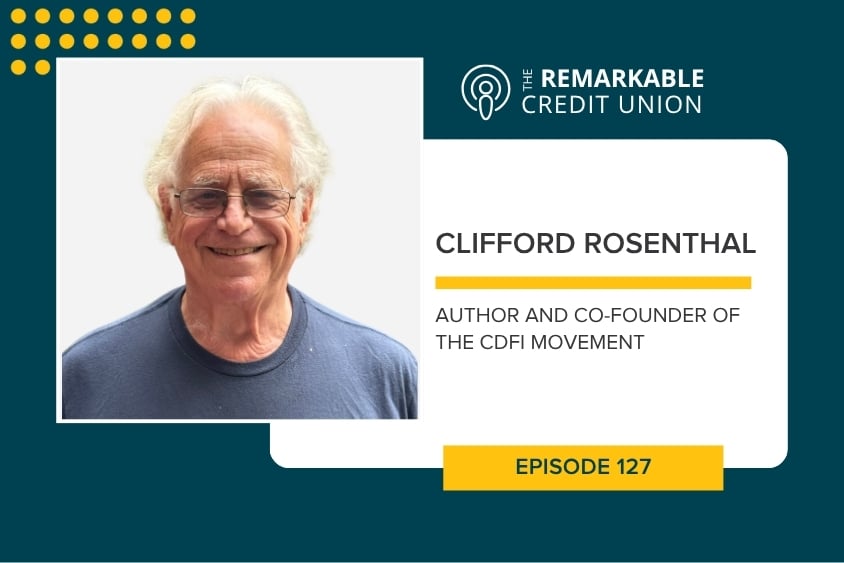
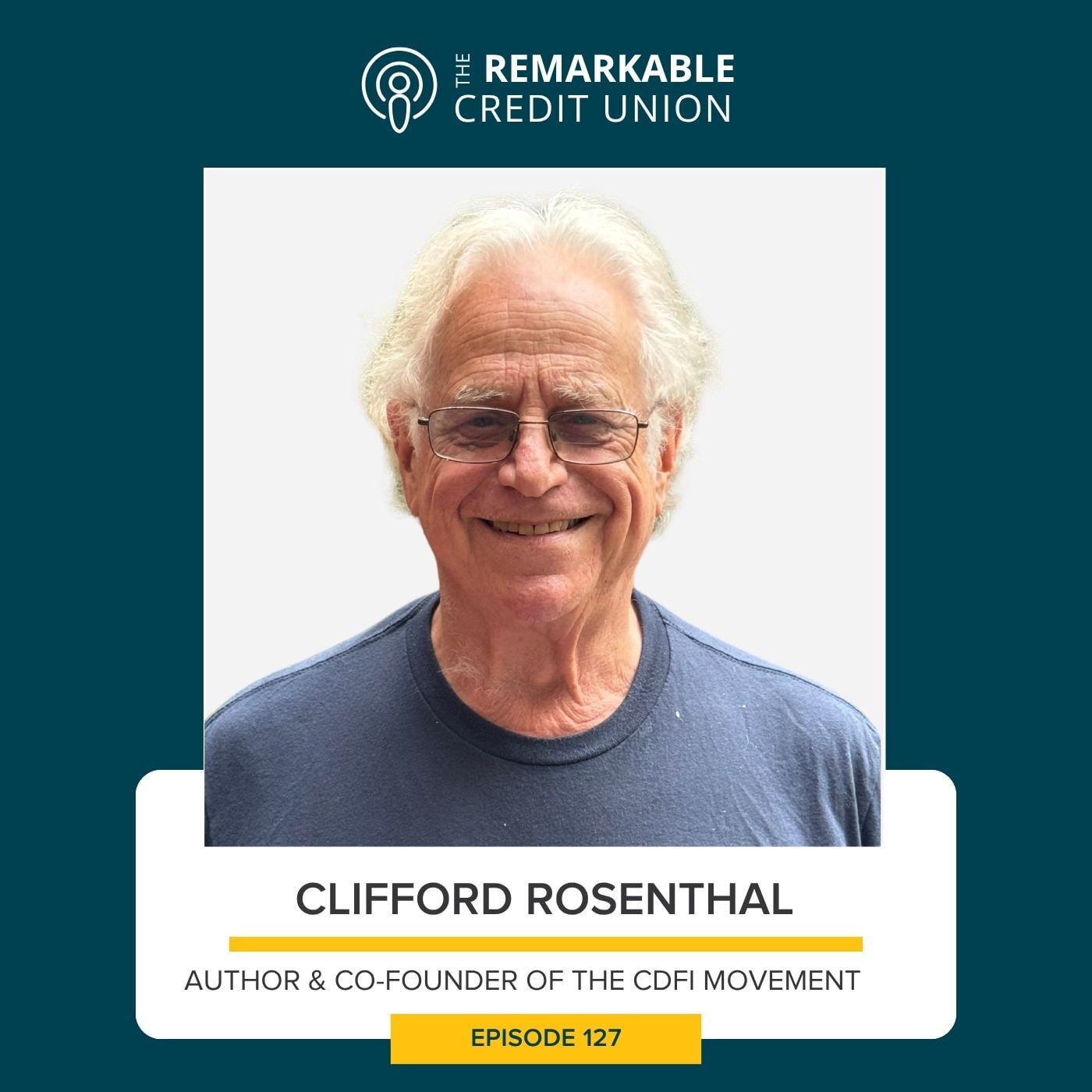
In this episode of The Remarkable Credit Union Podcast, we talk to Clifford Rosenthal—author, co-founder of the CDFI movement, and National Cooperative Hall of Fame inductee—to reflect on the history of community development finance and what is now called for during times of political upheaval, rapid technological evolution, and increasingly automated customer touchpoints.
Together, we tackle this month's BIG question:
Over the past few decades, where has the credit union movement gained ground when it comes to community development and financial inclusion, and what should be its primary focus in the years ahead?
Key takeaways:
- Despite recent turmoil, the CDFI movement continues to grow: Over many decades, the Community Development Financial Institution (CDFI) movement has transitioned from the margins to the mainstream, expanding significantly through grassroots advocacy and truly showing up for the communities they serve during major crises like the Covid pandemic.
- The credit union movement is rooted in inclusion and equity: From the very beginning, the credit union and cooperative movements have been inherently tied to serving excluded populations, making racial justice and financial equity foundational to their core mission — particularly when it comes to rectifying historical disenfranchisement in the financial sector. Even though the current administration has stoked fear around talking openly about diversity, equity, and inclusion, it's critical to keep this core mission front and center.
- Human connection is key to differentiation and innovation: Amid increasing reliance on technology and automated messaging, credit unions differentiate themselves most effectively through high-touch, community-focused services and grassroots innovations, like mobile branches, that directly meet people's needs.
Resources & links:
- Accessing Neighbourhood Capital: The Community Development Finance Trilogy by Clifford Rosenthal.
- Inclusiv: Formerly known as the National Federation of Community Development Credit Unions, with a mission to help low- and moderate-income people and communities achieve financial independence through credit unions.
- CDFI Fund (Community Development Financial Institutions Fund): A federal fund supporting credit unions that serve low-income and minority communities.
- Lower East Side People's Federal Credit Union: A community development credit union based in New York City. See our podcast episode with Alicia Portada, former Director of Communications and Community Engagement at Lower East Side People’s Credit Union.
- Consumer Financial Protection Bureau (CFPB): Specifically referencing its Office of Financial Empowerment.
- Community Reinvestment Act of 1977: Legislation encouraging banks to serve all sectors of their communities, including low- and moderate-income areas.
- Paycheck Protection Program (PPP): The federal relief program launched during the COVID-19 pandemic that expanded to include credit unions and CDFIs.
Read the transcript:
Katie:
Welcome to another episode of The Remarkable Credit Union Podcast. We created our podcast to help credit union leaders think outside of the box about marketing, technology, and community impact. The Remarkable Credit Union is brought to you by PixelSpoke, an employee-owned cooperative that works with credit unions to create user-friendly, high-converting, award-winning websites. Each episode, we bring on expert guests from the credit union and broader cooperative movement for conversations about the intersection of marketing and social impact. Our goal is to challenge your preconceptions about business as usual and provide you with actionable takeaways that you can use to grow your membership, improve the financial health of your cooperative, and better serve your community. I'm Katie Stone, CEO and one of the co-owners at PixelSpoke.
Kerala:
And I'm Kerala Goodkin, also co-owner at PixelSpoke and the director of marketing and impact. And today we are excited to tackle our big question, which is over the past few decades, where has the credit union movement gained ground when it comes to community development and financial inclusion, and what should be its primary focus in the years ahead?
So I can't think of a better guest to help us tackle this question. We're excited to welcome Clifford Rosenthal, who co-founded the CDFI movement, stands for Community Development Financial Institutions, and served as president of what was formerly known as the National Federation of Community Development Credit Unions, now known as Inclusiv. He has written a trilogy of books about community development finance and is currently writing a book with a working title of Miracle on East 3rd Street, which I love, about the Lower East Side People's Federal Credit Union. We had a guest a while back from this credit union, which is doing very impressive things in the realm of community development.
Cliff later served as the first director of the Office of Financial Empowerment of the Consumer Financial Protection Bureau and is in two halls of fame. In 2019, he was inducted into the African American Credit Union Coalition Hall of Fame and in 2024 into the National Cooperative Hall of Fame. And just a quick fun fact, before devoting his career to the credit union movement, he worked as a food co-op organizer and as a Russian historian and translator. Welcome, Cliff. It's so nice to have you.
Clifford:
Good to be here.
Kerala:
Oh, there is so much to talk about, so we're going to try to narrow it down a little bit, but we introduced you as the co-founder of the CDFI movement, and I'm realizing we are big champions of CDFIs, but I'm realizing I don't know a lot about how that movement came to fruition, and I was wondering if you could walk us through the beginnings of this movement.
Clifford:
Sure. I wrote about it at a considerable length in the first book of my trilogy, Democratizing Finance: Origins of the CDFI Movement, which traces the roots of this movement all the way up to Benjamin Franklin and through the 19th century, the Friedman's Bank serving civil war, Black veterans and so forth, as well as the community development efforts in the 1960s and '70s.
Honestly, I conceived this movement from our perspective because of the extreme need for capital among credit unions that specialized in serving low income communities. There had been an unsuccessful effort in the 1960s during the war on poverty to establish hundreds of these institutions and at local anti-poverty organizations. Most of them failed. The organization that I headed, that I came to head, the National Federation, represented those institutions, but they were a shrinking number. And it became clear to me as I worked in that organization that without sources of additional capital, the movement was largely going to become extinct.
So in the late 1980s, I basically formulated the notion of a national federal entity specifically to invest in institutions like ours as well as community development banks and loan funds, brought together a few people of like mind in 1990, 91. And the short story is while we would've been voices in the wilderness, Bill Clinton was meanwhile campaigning for president on a platform of creating 100 "community development banks" and 1,000 "community development loan funds". And essentially we merged our vision and our ideas with his still somewhat unformed but well-intentioned ideas. And that really was the origin of the push to establish the CDFI fund and expand the CDFI movement.
Katie:
That's really fascinating. I did not know that. Sounds like a lot of kismet and synergy around the timing. So now fast-forward to the more recent past, your most recent book, Community Development Finance, which came out earlier this year, follows the recent roller coaster of the CDFI movement from its response to COVID and George Floyd to its uncertain future under the current administration. So I'd like to start by going back to 2020. Can you tell us how did this very eventful year impact community development finance?
Clifford:
Yes. So I think it's important first of all, for people to remember the history in years to come. As you may remember, the very first weeks of the COVID-19 pandemic were times of incredible uncertainty. No one knew whether it was going to last for days, for weeks, for months, or indeed indefinitely. So there was a great deal of basically kind of adapting to the uncertainty of this situation. Credit unions in particular had to basically look to address increasingly urgent needs among their members, some of whom were without employment and so forth. They had to adapt to serving remotely in some cases, to shifting staff in order to cover the times. If you remember, people were terrified about COVID before there was a vaccine. So it was a time of tremendous adaptation to it. And in retrospect, it's remarkable both from the community development perspective, but from the perspective of serving members as any sort of credit union that they were able to come through in this crisis.
What mattered most of all in terms of the transformation of CDFI and the implication for credit unions was the federal efforts to alleviate the situation. First of all, by the Paycheck Protection Program. This program was launched very hastily. It went to the banks and left out the individuals, the communities, the small businesses that did not have banking relationships, and that included folks who were members of many credit unions. What became evident over the months was that entire low income and minority communities were being left out of this process. That really spurred a drive within Congress to somehow rectify this situation.
And successive waves of this Paycheck Protection Program extended it to credit unions and enabled them to reach out much more broadly than they ever had. They were not restricted only to their members. They reached out to small businesses that they had never touched before to address housing needs and so forth, and to really ally themselves with municipal and state government that were trying to find a way to get resources to people who needed it. Credit unions played an enormous role and it was transformative and it led to the establishment of what was an unprecedented $12 billion program for community development financial institutions and minority financial institutions.
Kerala:
Yeah, I remember that time and just thinking about the response of credit unions versus the big banks and how much more effective credit unions and community financial institutions were at getting those funds out because they were so embedded in the community. It was just a huge advantage for them.
Clifford:
Yeah, that's right. And really what it was on a national public scale was proof of concept. The notion of CDFI, many of us knew about it. There were 1500 of them, which was far shot from when we started the movement in the early '90s. But in general, in the halls of Congress or in the public, CDFIs were not very well known. Their role in stepping into the gap during those difficult months and years put them on the map, both in terms of Congress in a bipartisan way and in terms of the public and the banking world in a way they never had been.
Katie:
Probably a good segue. I'd love to fast-forward now to 2025 when the future of the CDFI fund was suddenly cast into great uncertainty. How would you characterize the movement now and how has it been impacted by the second Trump administration?
Clifford:
So certainly in the early months of the Trump administration, there was widespread anxiety and fear and among some CDFI credit unions and loan funds and banks, a concerted effort to step back. There was a fear of basically using language that would disqualify them from this administration. From the beginning, there were mixed signals because on the one hand, the Secretary of Treasury was saying good things about CDFIs and so forth. On the other hand, the head of the Office of Management and Budget was saying, "Let's cut those guys out. Let's cut the program out entirely." So there was confusion, there was mixed messaging, and so forth. And certainly there was a fear that the movement was going to be wiped out.
It became clear, however, that CDFIs had built a kind of strength politically that really very few programs had, particularly this was the work of Senator Warner in Virginia and Senator Crapo, who was a Republican from a rural area in Idaho. And remarkably, they put together a Senate CDFI caucus of 14 or so members of Congress, senators, equally Democrats and Republicans, and they became a powerful force for sustaining that program. So I think a lot of the groundwork and the advocacy that CDFIs had done over the course of years was really paying off and big time till really very recently to the last couple of weeks of September 2026. It was really unclear whether this would be a success or not, because if the money did not get out by September 30th this year, it would have been lost. In the end, it did get out to the tune of, I think, $289 million, which was an extraordinary victory and a validation both of the grassroots work that credit unions and the movement generally had done and congressional supporters.
Kerala:
I'll say that despite all the turmoil, what impresses me so much about this movement is how the extent to which it manages to be bipartisan in a day and age where so few things are bipartisan, there seems to be strong support on both sides for community development, financial institutions, and credit unions within that as well. We talked a bit about COVID in 2020 and the PPP rollout. It was a very eventful year, and one other big thing going on there was the aftermath of George Floyd's murder and the massive Black Lives Matter protests. So I wanted to talk a bit about racial justice and equity.
You are very vocal that you see these as intricately linked to the core mission of the credit union movement, and I would agree with that, but I'm not sure everyone makes that connection, including people who work at credit unions. And I was just wondering if you could talk a bit about why you see racial justice and equity work as so foundational to the movement.
Clifford:
Yes, I think you have to look back to the roots of the credit union movement. This was a movement in the early 20th century for the excluded. It was not specifically on racial grounds, that's certainly true, but it was for the benefit of people who are being excluded from the mainstream financial system. It's really not a coincidence that it emerged in immigrant communities in New Hampshire as well. So I think that's one through line through the history of the movement, and I think it's an important part of a legacy that credit unions need to be cognizant of and honor, in fact. So exclusion and disenfranchisement are not certainly only along racial lines or ethnic or national origin lines as well, but I think that they're a part of it.
And if you look at the history of banking in the United States, exclusion was very much linked to racial and ethnic discrimination. The Community Reinvestment Act in 1977 was passed in order to encourage banks as strongly as regulators could to serve all sectors of the community, including low and moderate income parts. And though those are not identical with racial and ethnic characteristics, there is more than an incidental connection and a concentration in those communities. So it's hard to separate them ultimately if you look seriously at the roots of this movement.
Kerala:
Yeah, I know. Our own hometown of Portland, Oregon has a pretty atrocious history of redlining that we are still working to reconcile, very much linked to financial empowerment and wellbeing.
Katie:
All right, so pivoting a little bit, you have been a part of the credit union movement for a long time now, so I'd be curious to get your perspective on a couple of trends that we've been seeing. The first one is the dramatic consolidation of credit unions over the past decades through mergers and acquisitions. How do you think this trend has impacted community development finance?
Clifford:
I think you have a couple of not contradictory trends, but let me put it this way. When I came to the Credit Union Movement in 1980, please don't do the math. When I came to the Credit Movement in 1980, there were 20,000 some odd credit unions in the United States. I came to a movement that was on its last legs of those credit unions that were specifically mission directed to serving low income communities. When I came to the movement, there were a hundred of these out of 20,000. It was significantly less than 1%, and we shrank further until the late 1980s when we were able to finally build up some momentum and push for the CDFI fund as well.
Today, Inclusiv, which was formerly the National Federation of Community Development Credit Unions, but has been working continuously since that time. Inclusiv counts a membership of about 500 out of approximately 4,000 and change credit unions of all types. So what that tells you is that there are approximately 12, 13, 14% of all credit unions in the United States, that's a quantum leap. And if you look at it that way of kind of a reorientation or a rediscovery of the roots of this movement from the early days.
I put it this way, as a movement serving disadvantaged, excluded people and communities, we have moved from the margins to the mainstream. You look at the advocacy for the CDFI field during my many years running the National Federation, we were a voice of the wilderness. We were actually quite on the margins of the mainstream credit union movement, which regarded us with some suspicion. What are you people doing looking for federal monies? This is going to endanger our tax exemption. Now, if you look at it, you see America's Credit Unions, you see the Defense Credit Union Council and other trade organizations that as well as inclusive are arguing for the importance of CDFIs and specifically the credit union role in that. I think that's a major transformation. And needless to say for me, it's tremendously encouraging to see that we are no longer marginalized voices in the wilderness saying we've got historic role to serve people who are not getting served by banks. Let's do it.
Katie:
Well, I think that that leads very nicely into our next question. I think Kerala and I would agree that credit unions and cooperatives more broadly are one of America's best kept secrets. We would love to evangelize credit unions and the cooperative movement even more than we are trying to do now. But what are the challenges that you see when it comes to the mainstream understanding and recognition of this movement? Why don't more people know about credit unions?
Clifford:
Well, that's a question that we've been asking for literally the first day that I walked into the National Federation in 1980. Cooperatives certainly exist in the United States, agriculture, the cooperatives, particularly. The cooperative movement is growing. There are more worker cooperatives than there was. And by the way, you folks have a good idea of what that means and so forth, but cooperatives have not been part of the economic mainstream for the most part. And unfortunately, they have been tarred by association with socialism.
And this debate has taken a very different form over the last months and years. And remember, I'm here in New York City where Mamdani has been elected as part of the Democratic Socialists of America. So in the 1930s specifically, that was a bad mark. Cooperatives were seen as socialists/communist threats to democracy and so forth. Did it ever totally overcome that stigma? I'm not so sure. Where I think we are right now though, over interesting possibilities because the word has lost some of its stigma, and you have a whole generation that is far more open to considering other ways of organizing finances than their predecessors were. I think that the increasing concentration of wealth over providing a decent living to the masses of people is pushing folks to look for other ways. So I think there's a great opportunity to both make the case for cooperatives in the way it wasn't really before to put credit unions on the map.
Katie:
Really well said.
Kerala:
Yeah, we're part of a fledgling worker co-op network here in Portland, Oregon, and are so surprised by how few there are in a city that prides itself on being weird and being alternative. So definitely hoping to change that. And I've done quite a bit of research on worker cooperatives. I remember while I was researching, I just typed in Google, "Are worker cooperatives..." I forget what my question was, but the first Google autofill suggestion was socialist. So there's definitely still that perception.
I did want to talk a little bit about the role of credit union marketing since we are in credit union marketing and a lot of our audience is marketers, particularly around innovation and differentiation. I feel like when we talk about innovation in general, it's mostly related to technology, and we do see a lot of credit unions trying to differentiate with more cutting edge technology and AI solutions now are flooding the marketplace. And we're not anti-technology, we're a technology company, but I have to say there's a lot of other ways to innovate, and I've often seen some of the best innovations coming from those smaller CDFI credit unions that really have boots on the ground. So I'm just wondering if you have examples of credit unions really differentiating and innovating, not so much through flashy technology, but just by virtue of being close to the communities they serve.
Clifford:
There's some excellent examples, and they're not high-tech, namely mobile vans bringing the credit union to people. Stepping Stones in Delaware was one of them for sure. My credit union, which I'm a member, Lower East Side People's Federal Credit Union, along with another credit union, got a mobile van, which started serving Staten Island, which had never had a CDFI and was not really dense with credit unions either. They brought it to the Bronx as well. But it's true in urban areas, it's true of rural areas. On the Lakota Sioux Reservation, I believe there's a mobile van bringing it to people. Even those that are not trying to reach those sorts of areas, I think that COVID and the constraints that put on was a real push to get credit union services to people where they were at. Other credit unions had roving staff members that went around and met with community organizations in other ways.
So yeah, mobility, taking the credit union message to where people are at, I think is pretty basic. It's not high-tech. It revolves some capital expenditures and so forth. But we talk about high touch as a distinguishing feature of credit unions, and it's not a new term, but I think it is as true now as it was in the past. You get bombarded every day with AI generated messages, whether it's politics, whether it's commerce, and they're intruding into your space, literally, into your tech space and so forth to an extremely annoying sense. The human contact is rare. It's becoming a matter of life and death in terms of controlling AI, as you've basically seen in the previous weeks when some AI initiated things have gone rogue. So human touch is essential. It is a potential strength for sure of the credit unions. And I'm sorry not to have a new innovative idea about it, but basic human context can never be overrated. It's fundamental. It's what builds attachment to an institution.
Even take a look at your services and things like life insurance for savings account is probably not used for many, many credit unions today. I want to tell you a story about how it mattered very closely in my life. There was a person who cleaned my neighbor's house and she lived in a low income area. She was really strapped and so forth. My neighbor, Rachel, co-signed a loan for her with the credit union. Rachel was tragically killed in a bicycle accident in the park near me. It turns out because of credit union insurance, she is a co-signer, the policy became active and it paid off to Esther and it paid off the ability for her to get a roof on her house. And my goodness, that was life-changing for her. And it was one of those services that the credit union did that you would never get from a bank. And I guess it never has left me that it's things like that that made me think that credit unions really are and can be something special.
Kerala:
Absolutely. Having just had to replace the roof on my house, I can attest to how monumental that is to get financial help with that. I love that story.
Katie:
All right. We have some rapid fire questions for you just for fun to wrap things up here. So I'd love to hear what is your favorite go-to comfort food?
Clifford:
Okay. Well, I live in New York and specifically in Brooklyn, so I might be expelled if I didn't mention a bagel, but we have Chinatown's around New York City, so I'll have to mention shredded chicken and beef Hunan style is another one.
Katie:
Nice. Sounds good. And if you could have dinner with one historical person, who would that be?
Clifford:
Two. Nelson Mandela as a world historical figure, and within the credit union movement, Dora Maxwell. Dora Maxwell was a credit union organizer, par excellence. I have helped organize up to a dozen credit unions in my life, and I've always dealt a tremendous affinity with other organizers. So Dora Maxwell would be the credit union person.
Katie:
I would join that dinner. That sounds neat. And finally, what's a place you'd like to visit that you've never visited?
Clifford:
So again, I'm a historian, so forgive me if I resort to the past. Cuba in the 1960s, in the early days after the revolution when art and literature and movies were flourishing in a way that very sadly they've been oppressed ever since. Yep.
Katie:
Great choice.
Kerala:
All right. Well, it's time for our final take. So just as a reminder, our big question today was over the past few decades, where has the credit union movement gained ground when it comes to community development and financial inclusion and what should be its primary focus in the years ahead? So a big challenge, but in just a few sentences, Cliff, can you summarize your thoughts on this?
Clifford:
I think we've advanced a long way in terms of community development finance, but more broadly mission focused on the underserved. That is part of what it means to become a community development financial institution. There's been a lot of progress made, and I would very much encourage and hope credit unions to basically stay the path, not to retreat in the face of political opposition, regimes and administrations come and go and so forth. And the basic mission is one that credit unions should continue to honor and advertise and put up front forever. I mean, it's through their history and it makes good sense.
Let me just tell you this by way of example. I lived up the block from a Bank of America in New York City. I opened up the New York Times one day and I saw a full of page ad, and what did it talk about? Not interest rates. It talked about community development finance and how that big bank was helping CDFIs. And wow, I thought, that really makes a difference. I think that that bank might be worth looking at. I think that what credit unions have achieved and have done in terms of becoming CDFIs and adopting that mission is something that they should publicize upfront and not retreat in any way.
Kerala:
I appreciate that message, especially good for marketers to note. Wonderful. Well, thank you so much for joining us. We really enjoyed the conversation.
Clifford:
My pleasure.
Katie:
Yeah, it's really been an honor to hear your thoughts.
Clifford:
Great. Well, keep at it with your worker-owned enterprise. It always warms my heart to see that. And particularly as you as who I would, from my perspective are certainly the younger generation who are going to carry this forward, that gives me great hope as well.
Kerala:
Awesome. Wonderful.
Well, what an inspiring and rich conversation. Lots of layers there. To boil it down to a few key takeaways, I was really heartened to hear that despite recent turmoil, the CDFI movement just remains strong and continues to grow. Over quite a few decades, the movement has really transitioned from the margins to the mainstream and has expanded significantly through both grassroots advocacy and also just by truly showing up for the communities that these community development financial institutions serve, especially during times of major crisis like the COVID pandemic.
Secondly, the credit union movement is rooted in inclusion and equity and something we need to be talking about. And from the very beginning, the credit union and the broader cooperative movements have just been inherently tied to serving excluded populations. And that makes racial justice and financial equity foundational to their core mission, especially when it comes to rectifying historical disenfranchisement in the financial sector. And yes, the current administration has stoked fear around talking openly about diversity, equity, and inclusion, but let's not lose sight of this core mission.
And lastly, we've said it before on this podcast and we will keep saying it, that human connection is key to differentiation and innovation for credit unions. I could certainly relate to Cliff talking about just the inundation of AI and automated messages we get these days and how credit unions can differentiate themselves most effectively by being human.
To be clear, we have a lot of credit unions tell us that friendly service is their core differentiator. I don't believe that's a core differentiator. I believe that's table stakes for good business. But what I'm talking about is really the high touch community focused services and the grassroots innovations, like the mobile branches that directly meet people's needs.
Thanks for joining us today for another great episode. The Remarkable Credit Union is brought to you by PixelSpoke, an employee-owned cooperative that works with credit unions to create user-friendly, high converting, award-winning websites. You can learn more and check out our work at pixelspoke.co-op. That's pixelspoke, all one word, .C-O-O-P. Until the next time, I wish you the best of luck in making your credit union remarkable.